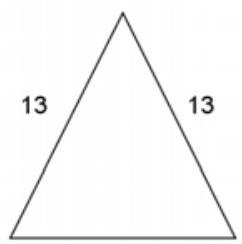
Um triângulo isósceles tem base medindo 10cm e dois lados iguais a 13cm. É possível mudar a base do triângulo e obter outro triângulo isósceles com mesma área?
This one wants a proof. Work it on paper, read the official solution, then mark
yourself honestly — the ladder only means something if the record is true.
Official solution
Solution:
Em um triângulo isósceles, a altura relativa à base coincide com a mediana. Traçando esta altura, obtemos dois triângulos retângulos com catetos medindo h e 5, e hipotenusa 13. Pelo Teorema de Pitágoras temos: h2+52=132⇒h2=132−52=144⇒h=144=12 Logo a área do triângulo é A=2b×h=210×12=60cm2.
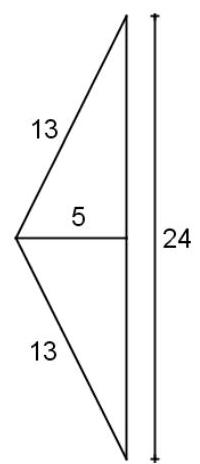
Vamos agora "colar" os 2 triângulos retângulos ao longo do lado medindo 5, obtendo um triângulo isósceles com base 12+12=24cm, os lados com 13cm e a altura relativa à base igual a 5cm. Logo, este novo triângulo isósceles tem também área igual a 224×5=60cm2.
Source: MathNet,
licensed CC-BY-4.0.
Statement and solution reproduced as published; topic, difficulty and ordering added
by this site.