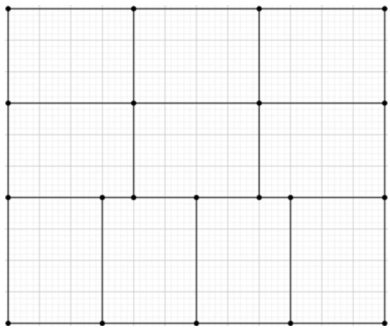
A farmer has 2 rectangle lands of size 120 m×100 m.
a. On the first land, there are 9 circle gardens of diameter 5 m. Prove that regardless to the position of gardens, he always can builds a rectangle garden of size 25 m×35 m.
b. On the second land, he builds a convex polygon lake such that the shortest distance from any point on the boundary of the land to the lake is at most 5 m. Prove that the perimeter of the lake is at least 440−202 m.
This one wants a proof. Work it on paper, read the official solution, then mark
yourself honestly — the ladder only means something if the record is true.
Official solution
a. Consider the rectangle ABCD with AB=CD=120 and AD=BC=100. Divide it into 10 subrectangles of size 30×40 as follows.
Consider 9 centers of the given gardens. By the pigeonhole principle, there is some subrectangle that does not contain any point among them. Suppose it is the rectangle XYZT with XY=ZT=40, XT=YZ=30. Consider one more rectangle X′Y′Z′T′ lying inside XYZT such that the sides of the two rectangles are pairwise parallel and the gap equals 2.5, then X′Y′Z′T′ has the size 25×35. It is clear that the rectangle X′Y′Z′T′ does not share any point with any garden, so the desired result will follow.
b. Consider the rectangle ABCD with AB=CD=120 and AD=BC=100. Let L be the boundary of the lake. From the given hypothesis, there are four points A′,B′,C′,D′ lying on L such that AA′,BB′,CC′,DD′≤5. Since the lake is a convex polygon, then A′B′,B′C′,C′D′,D′A′ do not overlap. Hence, the length of L is at least A′B′+B′C′+C′D′+D′A′. Denote A1 as the projection of A′ to AD, A2 as the projection of A′ to AB, and similarly define the points B1,B2,C1,C2,D1,D2. We have A1A′+A′B′+B′B1≥A1B1≥AB=120. By the same way, we get B2B′+B′C′+C′C2C1C′+C′D′+D′D1D2D′+D′A′+A′A2≥100,≥120,≥100. These imply that A′B′+B′C′+C′D′+D′A′+(A′A1+A′A2+B′B1+B′B2+C′C1+C′C2+D′D1+D′D2)≥440. Finally, by applying Cauchy-Schwarz's inequality, we have A′A1+A′A2≤2(A′A12+A′A22)=2A′A22≤52. Similarly, we also have B′B1+B′B2≤52, C′C1+C′C2≤52, D′D1+D′D2≤52.
From these inequalities, it is clear to conclude that the length of L does not exceed 440−202.
Source: MathNet,
licensed CC-BY-4.0.
Statement and solution reproduced as published; topic, difficulty and ordering added
by this site.