GeometryDifficulty 8.2Prove itTeam selection tests for BMO 2018 · Saudi Arabia · 2018
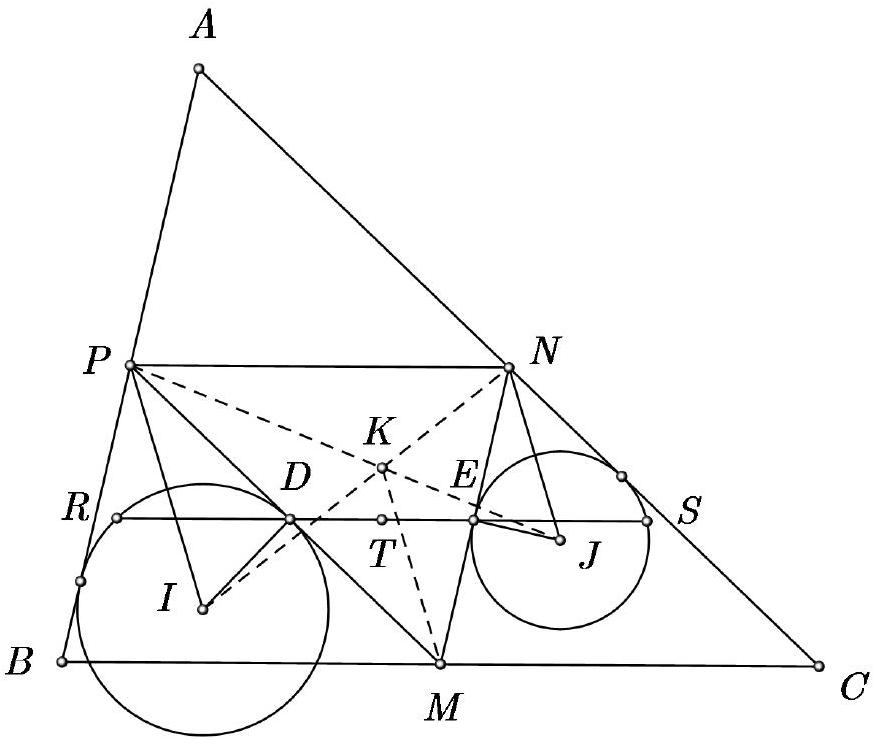
Let ABC be a triangle with M,N,P as midpoints of the segments BC,CA,AB respectively. Suppose that I is the intersection of angle bisectors of ∠BPM, ∠MNP and J is the intersection of angle bisectors of ∠CNM, ∠MPN. Denote (ω1) as the circle of center I and tangent to MP at D, (ω2) as the circle of center J and tangent to MN at E.
1. Prove that DE is parallel to BC.
2. Prove that the radical axis of two circles (ω1), (ω2) bisects the segment DE.
This one wants a proof. Work it on paper, read the official solution, then mark
yourself honestly — the ladder only means something if the record is true.
Official solution
1) Note that ∠MNC=∠MPB=∠A then by angle chasing, we have IP∥JN. Denote K=PJ∩IN then K is the incenter of triangle MNP. Hence, MK is the angle bisector of ∠NMP, thus MK∥IP. Denote X=IN∩MP then MKIP=XMXP=NMNP. Similarly, MKJN=MPNP. Thus JNIP=MNMP. Since △IPD∼△JNE then JNIP=NEPD. Therefore, MNMP=NEPD which implies that DE∥NP∥BC.
2) Suppose that DE cuts (ω1), (ω2) at R,S respectively. We have ERDS=JE⋅cos∠JESID⋅cos∠IDR=NE⋅sin∠NESPD⋅sin∠PDR=AB⋅sinBAC⋅sinC=1. Hence DS=ER. Denote T as midpoint of DE then PT/(ω1)=TD⋅TR=TE⋅TS=PT/(ω2), which implies that T lies on the radical axis of (ω1),(ω2). □
Source: MathNet,
licensed CC-BY-4.0.
Statement and solution reproduced as published; topic, difficulty and ordering added
by this site.