GeometryDifficulty 5.3Find the answerAMC 12 B · United States
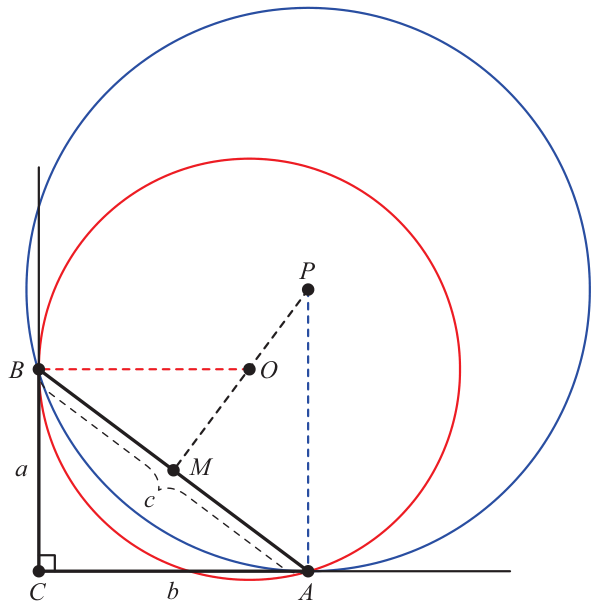
Right triangle ABC has side lengths BC=6, AC=8, and AB=10. A circle centered at O is tangent to line BC at B and passes through A. A circle centered at P is tangent to line AC at A and passes through B. What is OP? (A) 823 (B) 1029 (C) 1235 (D) 2573 (E) 3
Official solution
Answer (C): More generally, let a=BC, b=AC, and c=AB where a<b; then c=a2+b2. Because AB is a chord of both circles, their centers O and P must lie on the perpendicular bisector of AB. Letting M be the midpoint of AB, observe that △OMB is a right triangle, and radius OB is perpendicular to tangent BC, so it is parallel to AC. Thus ∠OBM=∠BAC, so △OMB is similar to △BCA, and OM=BC⋅ACMB=2bac.
Likewise, △AMP is similar to △BCA, so MP=AC⋅BCMA=2abc. Hence OP=MP−OM=2c(ab−ba)=2c(abb2−a2), which for the given △ABC is equal to 210(6⋅882−62)=1235.
OR
Let C be the origin of a coordinate system with B=(0,6) and A=(8,0). The circle centered at point O is tangent to BC at B, so O=(x,6) for some x. Similarly, P=(8,y) for some y. Points A and B lie on the circle centered at O, so (8−x)2+62=x2+02. This simplifies to 16x=100, so x=425. Points A and B also lie on the circle centered at P, so 02+y2=82+(y−6)2. This simplifies to 12y=100, so y=325. It follows that OP2=(8−x)2+(y−6)2=(47)2+(37)2=14449⋅25, whence OP=1235.
Source: MathNet,
licensed CC-BY-4.0.
Statement and solution reproduced as published; topic, difficulty and ordering added
by this site.