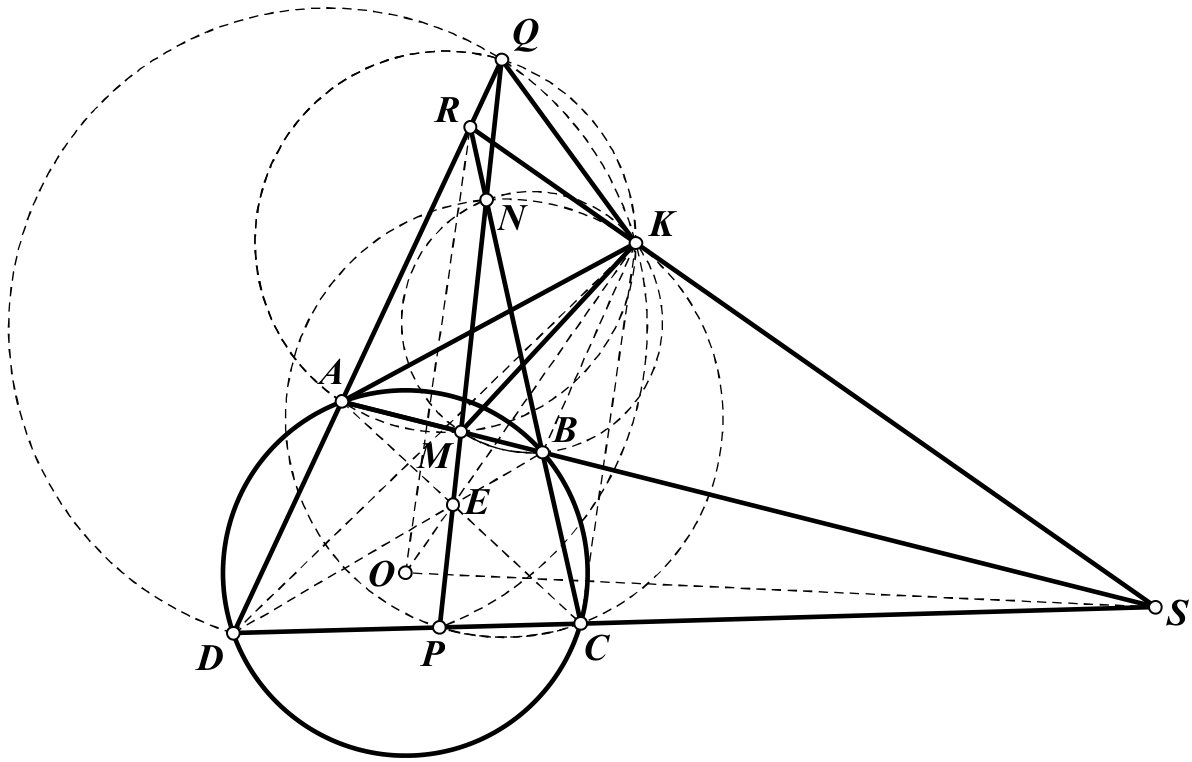
Let ABCD be a quadrilateral inscribed in circle (O,R) and is not a trapezoid. Two lines AC, BD intersect each other at E and the bisector of ∠AEB meets the lines AB, BC, CD, DA at M, N, P, Q, respectively.
1. Prove that four lines (AQM), (BMN), (CNP), (DPQ) concur at a unique point, name it as K.
2. Let min{AC,BD}=m. Prove that OK≤4R2−m22R2.
This one wants a proof. Work it on paper, read the official solution, then mark
yourself honestly — the ladder only means something if the record is true.
Official solution
1. Let R be the intersection of two lines AD, BC and S be the intersection of two lines AB, CD (because ABCD is not a trapezoid then R, S are quite specific). Assume that B lies between A, S and also lies between C, R as in the figure, the other cases can be proved similarly. Let K be the intersection of the circumcircles of triangles RAB, SBC, then ∠BKR+∠BKS=∠BAD+∠BCD=180∘ or R,K,S are collinear. Hence, we have RK⋅RS=RB⋅RC=RA⋅RD and SK⋅SR=SB⋅SA=SC⋅SD so two quadrilaterals ADSK and CDRK are cyclic, this infers K also belongs to two circles (RCD) and (SDA). Hence, we have ∠AKD=∠ASD=∠BSC=∠BKC and ∠ADK=∠ASK=∠BSK=∠BCK so two triangles KAD and KBC are similar. Then KBKA=BCAD=BEAE=BMAM, using the property of angle bisector in the triangle, we can get KM is the interior angle bisector of ∠AKB.
On the other hand, we have ∠RNQ=∠BNE=∠CBD−∠BEN=∠CAD−∠AEQ=∠RQN so ∠ARB=2∠BNM. From this result, we have ∠BKM=21∠AKB=21∠ARB=∠BNM and quadrilateral BMNK is also cyclic, which leads to K belonging to the circle (BMN). Similarly, we also have K belongs to circles (AQM), (CNP), (DPQ).
Next, we have to prove that K is the unique common point of these circles. In fact, two circles (AMP), (BMQ) have two common points: K, M and two circles (DNP), (CNP) have two common points: K, N. Therefore, if these four circles have two distinct common points, it leads to M, N coinciding, which is a contradiction. So K is the unique common point of these circles (AQM), (BMN), (CNP), (DPQ).
2. From the properties of power of a point, we have RK⋅RS=RB⋅RC=RO2−R2,SK⋅SR=SB⋅SA=SO2−R2 then RO2−SO2=RK⋅RS−SK⋅SR=RK2−SK2. It is easy to get OK⊥RS from the above result. And based on Brocard's theorem in cyclic quadrilateral ABCD, point E is the orthocenter of triangle ORS, hence OE⊥RS. Therefore, O, E, K are collinear. We also have ∠RKA+∠SKC=∠RBA+∠SBC=2∠ADC=∠AOC so ∠AKC+∠AOC=180∘ implies the quadrilateral AOCK is cyclic. Then EO⋅EK=EA⋅EC=R2−OE2⇒EO(EO+EK)=R2 or OK=EOR2. On the other hand, we also have EO≥max{d(O,AC),d(O,BD)}=max{214R2−AC2,214R2−BD2}=214R2−m2 Therefore, we conclude the inequality OK≤4R2−m22R2 (Q.E.D).
Source: MathNet,
licensed CC-BY-4.0.
Statement and solution reproduced as published; topic, difficulty and ordering added
by this site.