Let T be the symmetry point of A with regard to BC, F be the projection of A′ onto BC, M be the projection of T onto AC.
Since AC=CT, we have ∠TCM=2∠TAM. Since
∠TAM=2π−∠ACB=∠OAB, we have
∠TCM=2∠OAB=∠A′OB=∠A′CF, and
∠TCHA=∠A′CF+∠A′CT=∠TCM+∠A′CT=∠A′CE.
Because ∠CHAT,∠CMT,∠CEA′,∠CFA′ are right angles, therefore
CMCHA=CTCHA⋅CMCT=cos∠TCMcos∠TCHA=cos∠A′CFcos∠A′CE=CA′CE⋅CFCA′=CFCE,
i.e. CHA⋅CF=CM⋅CE, so HA,F,M,E are on the same circle ω1.
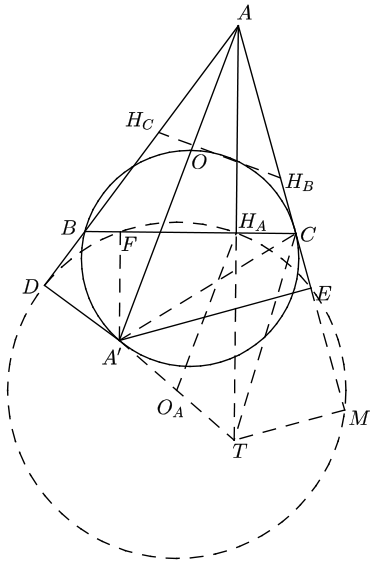
Similarly, let N be the projection of T onto AB, then HA,F,N,D are on the same circle ω2. Since A′FHAT and A′EMT are both right trapezoids, the perpendicular bisector of the segments HAF and EM meet at the midpoint K of the segment A′T, i.e. K is the center of circle ω1, KF is the radius of circle ω1. Similarly, K and KF are also the center and the radius of circle ω2, respectively. Thus, ω1 and ω2 are the same, D,N,F,HA,E,M are on the same circle. So OA is the midpoint K of A′T, OAHA∥AA′.
Since ∠HCAO+∠AHCHB=2π−∠ACB+∠ACB=2π, we have AA′⊥HBHC, thus OAHA⊥HBHC, therefore OAHA,OBHB,OCHC all pass through the orthocenter of △HAHBHC.