a) Redefine the point K as the orthocenter of the triangle BCD, then B is also the orthocenter of the triangle KCD, we will show that K∈PQ. Construct the parallelogram BCDT.
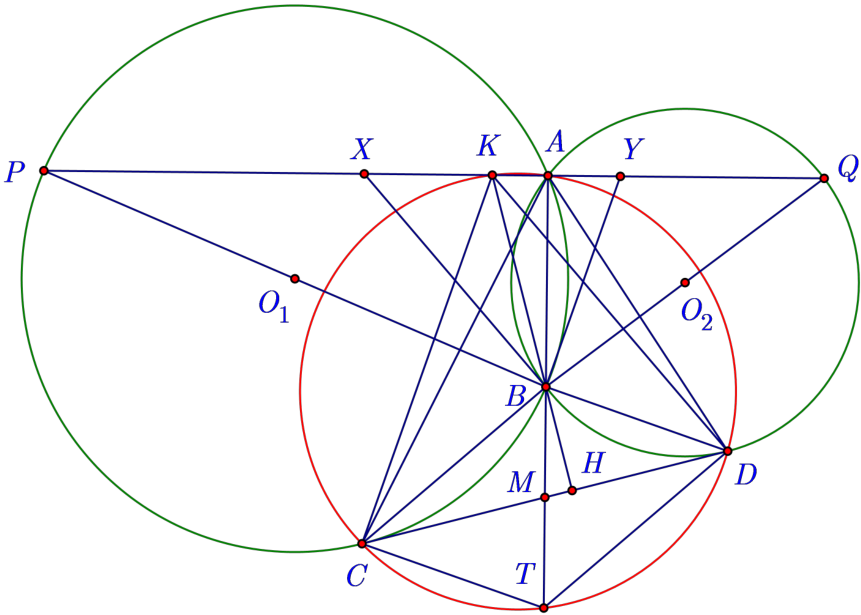
Since K is the orthocenter of triangle BCD, BC⊥KD, and BC∥TD so TD⊥KD. Similarly, TC⊥KC so KCTD is inscribed in a circle of diameter KT. Since CD is a common tangent to (O1),(O2), ∠BCD=∠CAB, ∠BDC=∠DAB. Therefore
180∘−∠CBD=∠BCD+∠BDC=∠CAB+∠DAB=∠CAD.
Since BCTD is a parallelogram, ∠CBD=∠CTD, hence 180∘−∠CTD=∠CAD entails ACTD internal. Therefore, the points A,C,T,D,K belong to the circle of diameter KT. Since BP,BQ are the diameters of (O1),(O2), ∠BAP=∠BAQ=90∘, so A,P,Q are collinear. It is left to prove that KA⊥AB. From KACD is inscribed, we have ∠KAC=∠KDC=90∘−∠BCD=90∘−∠BAC implies that
∠KAB=∠KAC+∠BAC=90∘.
Hence K,P,Q are collinear and thus the original problem is solved.
b) Draw the altitude BH of the triangle BCD and M is the midpoint of CD. We have
∠KBP=180∘−(∠CBP+∠CBH)=180∘−(90∘−∠BPC+90∘−∠BCH)=2∠BCH.
Since BX is the bisector of ∠KBP, then ∠KBX=∠BCM. We can see that AKMH is cyclic since ∠KAM=∠KHM=90∘ so ∠BKX=∠BMC. This implies that
ΔBKX∼ΔCMB⟹CMBK=MBKX.
Similarly, ΔBKY∼ΔDMB⟹DMBK=MBKY. And CM=DM so we get
MBKX=MBKY⟹KX=KY.
□