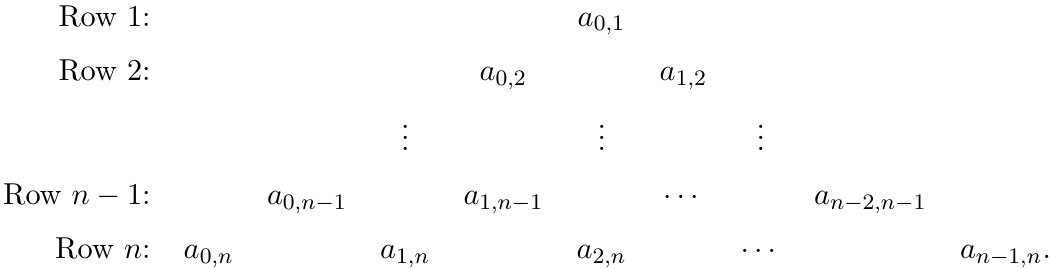
We begin by proving a lemma on the stability of triangular arrays.
Lemma 3. Let T be a stable triangular array with row sums s1,s2,…,sn. Then there is a unique index i such ai,n in T can be increased by one to get a new stable triangular array T+ with row sums s1,s2,…,sn+1. Additionally, if sn>sn−1, there is also a unique index j such that aj,n in T can be decreased by one to get a new stable triangular array T− with row sums s1,s2,…,sn−1.
*Proof.* For 0≤i<j≤n−1 let xi,j=ai,n−ai,j−aj,n, and let xj,i=1−xi,j. Notice that all the xi,j are either 0 or 1 by the fact that T is stable. Consider these as entries of an n×n matrix M with 0s down the diagonal, we get the adjacency matrix of a complete directed graph (also known as a tournament). Note that if we increase ai,n by 1 for some i, this is the same as increasing all xi,k by 1 for all k=i. This preserves the condition of stable arrays if and only if all xi,k are equal to 0. Likewise, decreasing aj,n by 1 requires all xj,k to be 1. So we must find exactly one column of all 0s and exactly one column of all 1s in M, excluding the diagonal entries.
We now show the tournament M is transitive. If for i<j<k we have xi,j=xj,k=0, then
0=xi,j+xj,k=ai,n−ai,j−aj,k−ak,n≥ai,n−ai,k−ak,n=xi,k,
so xi,k=0. Similarly, if xi,j=xj,k=1, then
2=xi,j+xj,k=ai,n−ai,j−aj,k−ak,n≤ai,n+1−ai,k−ak,n=xi,k+1,
so xi,k=1.
Since this tournament is transitive, it is well-known there exists exactly one i such that xi,k=1 for all k=i, and likewise exactly one j such that xj,k=0 for all k=j. These are the desired columns.
It remains only to show that the condition that all the entries are nonnegative is preserved if sn>sn−1; this means we need to show aj,n>0. Suppose aj,n=0. All the other entries of row n are nonnegative integers, this means aj,n will be less than all other elements after the decrement. We also know from above that decreasing aj,n by 1 will preserve the condition of being stable, implying that row n is still non-increasing. Since aj,n will be the minimum after the decrement, j=n−1. This in turn implies that xn−1,k=1 for all k, or rather xk,n−1=0 for all k. Therefore, ak,n=ak,n−1+an−1,n=ak,n−1. Summing these up for k from 0 to n−2 and remembering that an−1,n=0, we get sn−1=sn, a contradiction to the assumption that sn>sn−1. So aj,n>0, and the lemma is proven. □
To prove the problem, we induct on n. The base case n=1 is clear, since a0,1 must be equal to s1. Suppose it is true for n−1, and consider an arbitrary nondecreasing sequence s1,s2,…,sn. By the inductive hypothesis we can choose a unique (n−1)-row stable triangular array with entries ai,j for 0≤i<j≤n−1 that satisfy the row sums s1,s2,…,sn−1. It remains to show there is a unique way to assign the elements of row n, namely ai,n for 0≤i≤n−1, to satisfy the row sum sn while still keeping the array stable.
We now prove that we can uniquely assign row n by another induction on sn. The base case is sn=sn−1. Note that ai,n−1+an−1,n≤ai,n. Summing this up for all i from 0 to n−2 gets that sn−1+(n−1)an−1,n≤sn−an−1,n. Since sn=sn−1 and an−1,n≥0, we must have equality, so the unique row n that works is an−1,n=0 and ai,n=ai,n−1.
Assume the inductive hypothesis is true for sn. Then we have a unique stable triangular array T with row sums s1,s2,…,sn. By the Lemma 3, there is a unique way to increment an entry in row n of T to get a new stable triangular array T+ with row sums s1,s2,…,sn+1, showing existence. To show uniqueness, suppose we had a second array T1+. Apply the Lemma 3 to show there is a unique way to decrement an entry in row n to get a new stable triangular array T1 with row sums s1,s2,…,sn. By the inductive hypothesis, T=T1. We can obtain T1+ by incrementing an entry of T1, the same as doing the earlier decrement in reverse. We can also obtain T+ by incrementing an entry of T. Finally, the statement of the Lemma 3 implies that there is a unique way to increment an entry of T to get a new stable array, so the increments done to T and T1 must have been the same. This shows that T1+=T+, so uniqueness of the stable array with row sums s1,s2,…,sn+1 has been shown. This completes both inductions and the proof.