Olympiad Maths Prep

Track / Stage 8 / 162 of 180 #1862 of 2000

Problem 1862

IMO Shortlist mid-range; USAMO P2/P5
Geometry Difficulty 8.8 Prove it VN IMO Booklet · Vietnam

Let ABCABC be an acute, non-isosceles triangle with H,O,OH, O, O' as its orthocenter, circumcenter, nine-point center, and D,E,FD, E, F as the midpoints of the segments BC,CA,ABBC, CA, AB, respectively. PP is an arbitrary point inside triangle DEFDEF. Let DP,EP,FPDP, EP, FP intersect (O)(O') again at D,E,FD', E', F', respectively. AA' is the reflection of AA through DD'. We define points B,CB', C' similarly.

a. Assume that PO=POPO = PO', prove that the circle (ABC)(A'B'C') passes through OO.

b. Let XX be the reflection of AA' with respect to the line ODOD. We define Y,ZY, Z similarly. Suppose that XH,YH,ZHXH, YH, ZH intersect BC,CA,ABBC, CA, AB at M,N,KM, N, K respectively. Prove that M,N,KM, N, K are collinear.

This one wants a proof. Work it on paper, read the official solution, then mark yourself honestly — the ladder only means something if the record is true.

Official solution

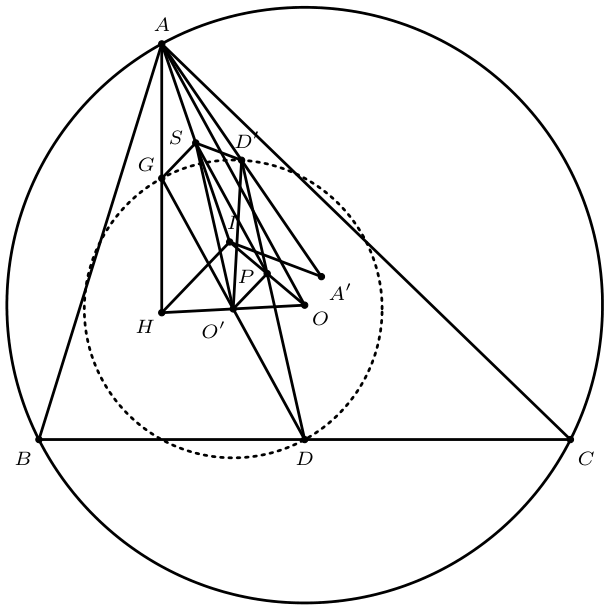
(a) Let II be the reflection of OO with respect to PP. Since OO' is the midpoint of OHOH, it follows that OPIHO'P \parallel IH. Moreover, we have PO=POPO = PO', thus IO=IHIO = IH.
Let S,GS, G be midpoints of AIAI and AHAH, respectively. We have
SP=12AO=12R=OD SP = \frac{1}{2}AO = \frac{1}{2}R = O'D
and SPAOODSP \parallel AO \parallel O'D, thus OSPDO'SPD is a parallelogram. It follows that DPOSDP \parallel O'S.
Furthermore, we have SP=12R=ODSP = \frac{1}{2}R = O'D', therefore SDPOSD'PO' is an isosceles trapezoid which leads to OP=SDO'P = SD' and
IH=2OP=2SD=IA. IH = 2O'P = 2SD' = IA'.
Thus IA=IH=IOIA' = IH = IO which implies AA' lies on the circle (I,IO)(I, IO). Similarly, BB' and CC' also lie on (I,IO)(I, IO). This leads to the conclusion of (a).

Figure 1

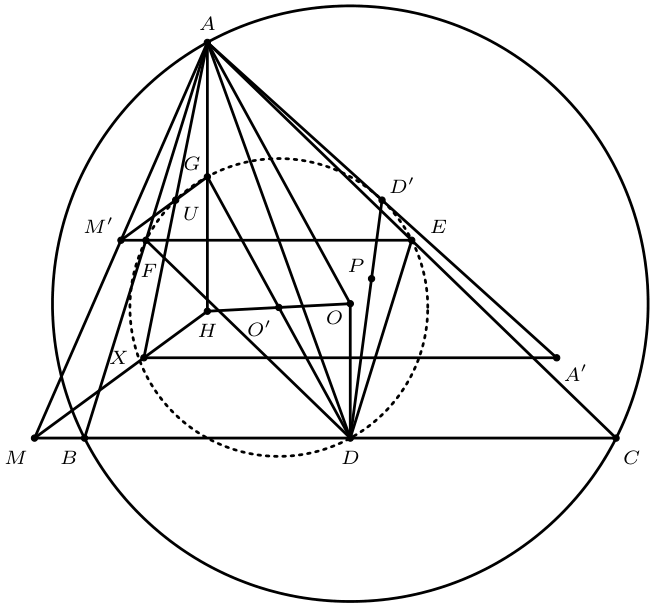
(b) Let RR be the radius of the circle (O)(O). It is obvious that GD=RGD = R. Consider the homothetic transformation with center AA and ratio 12\frac{1}{2} which sends B,C,A,X,H,MB, C, A', X, H, M and the perpendicular bisector of BCBC to F,E,D,U,G,MF, E, D', U, G, M' and the perpendicular bisector EFEF, respectively. Then MBMC=MFME\frac{MB}{MC} = \frac{M'F}{M'E} and UU is the reflection of DD' with respect to EFEF. Thus
MBMC=MFME=GFGEUFUE=R2DF2R2DE2DEDF. \frac{MB}{MC} = \frac{M'F}{M'E} = \frac{GF}{GE} \cdot \frac{UF}{UE} = \frac{\sqrt{R^2 - DF^2}}{\sqrt{R^2 - DE^2}} \cdot \frac{D'E}{D'F}.
Similarly, we can calculate NCNA\frac{NC}{NA} and KAKB\frac{KA}{KB}.

Figure 2

Since DDDD', EEEE', FFFF' are concurrent, it follows
DFDEFEFDEDEF=1. \frac{D'F}{D'E} \cdot \frac{F'E}{F'D} \cdot \frac{E'D}{E'F} = 1.
Thus MBMCNCNAKAKB=1\frac{MB}{MC} \cdot \frac{NC}{NA} \cdot \frac{KA}{KB} = 1, which implies M,N,KM, N, K are collinear. This is the desired result.

Source: MathNet, licensed CC-BY-4.0. Statement and solution reproduced as published; topic, difficulty and ordering added by this site.