Olympiad Maths Prep

Track / Stage 8 / 144 of 180 #1844 of 2000

Problem 1844

IMO Shortlist mid-range; USAMO P2/P5
Combinatorics Difficulty 8.8 Prove it International Mathematical Olympiad Shortlist · IMO

Let NN be a positive integer, and consider an N×NN \times N grid. A right-down path is a sequence of grid cells such that each cell is either one cell to the right of or one cell below the previous cell in the sequence. A right-up path is a sequence of grid cells such that each cell is either one cell to the right of or one cell above the previous cell in the sequence.
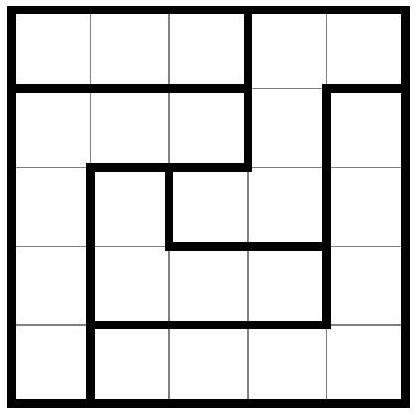
Prove that the cells of the N×NN \times N grid cannot be partitioned into less than NN right-down or right-up paths. For example, the following partition of the 5×55 \times 5 grid uses 5 paths.

Figure 1

This one wants a proof. Work it on paper, read the official solution, then mark yourself honestly — the ladder only means something if the record is true.

Official solutions — 2

Solution 1

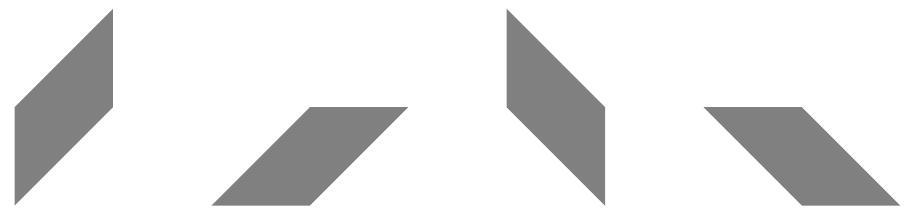
We define a good parallelogram to be a parallelogram composed of two isosceles right-angled triangles glued together as shown below.
Figure 2
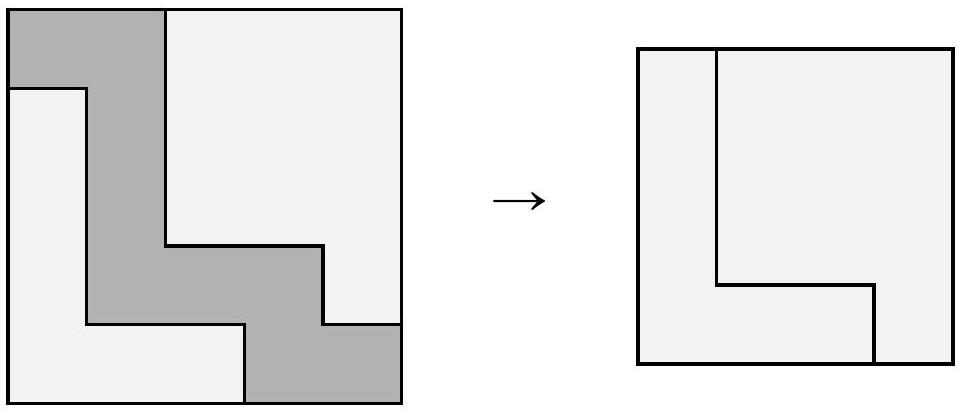
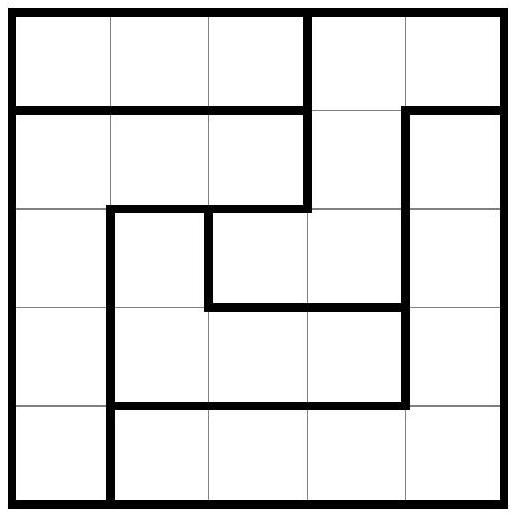
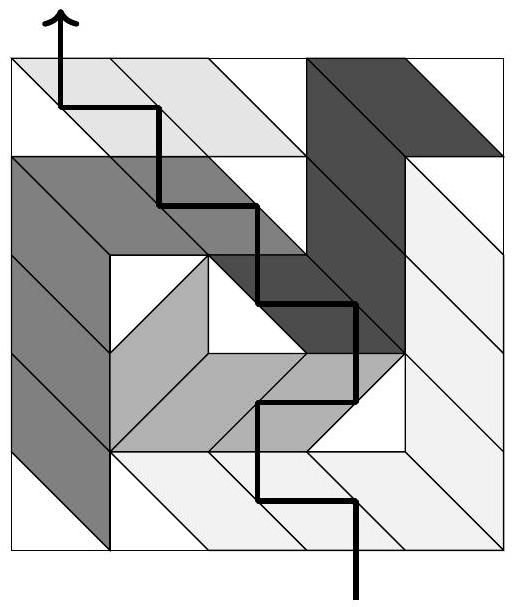
Given any partition into kk right-down or right-up paths, we can find a corresponding packing of good parallelograms that leaves an area of kk empty. Thus, it suffices to prove that we must leave an area of at least NN empty when we pack good parallelograms into an N×NN \times N grid. This is actually equivalent to the original problem since we can uniquely recover the partition into right-down or right-up paths from the corresponding packing of good parallelograms.
Figure 3
Figure 4
We draw one of the diagonals in each cell so that it does not intersect any of the good parallelograms. Now, view these segments as mirrors, and consider a laser entering each of the 4N4 N boundary edges (with starting direction being perpendicular to the edge), bouncing along these mirrors until it exits at some other edge. When a laser passes through a good parallelogram, its direction goes back to the original one after bouncing two times. Thus, if the final direction of a laser is perpendicular to its initial direction, it must pass through at least one empty triangle. Similarly, if the final direction of a laser is opposite to its initial direction, it must pass though at least two empty triangles. Using this, we will estimate the number of empty triangles in the N×NN \times N grid.
We associate the starting edge of a laser with the edge it exits at. Then, the boundary edges are divided into 2N2 N pairs. These pairs can be classified into three types:
(1) a pair of a vertical and a horizontal boundary edge,
(2) a pair of boundary edges from the same side, and
(3) a pair of boundary edges from opposite sides.
Since the beams do not intersect, we cannot have one type (3) pair from vertical boundary edges and another type (3) pair from horizontal boundary edges. Without loss of generality, we may assume that we have tt pairs of type (3) and they are all from vertical boundary edges. Then, out of the remaining boundary edges, there are 2N2 N horizontal boundary edges and 2N2t2 N-2 t vertical boundary edges. It follows that there must be at least tt pairs of type (2) from horizontal boundary edges. We know that a laser corresponding to a pair of type (1) passes through at least one empty triangle, and a laser corresponding to a pair of type (2) passes through at least two empty triangles. Thus, as the beams do not intersect, we have at least (2N2t)+2t=2N(2 N-2 t)+2 \cdot t=2 N empty triangles in the grid, leaving an area of at least NN empty as required.

Solution 2

We apply an induction on NN. The base case N=1N=1 is trivial. Suppose that the claim holds for N1N-1 and prove it for N2N \geqslant 2.
Let us denote the path containing the upper left corner by PP. If PP is right-up, then every cell in PP is in the top row or in the leftmost column. By the induction hypothesis, there are at least N1N-1 paths passing through the lower right (N1)×(N1)(N-1) \times(N-1) subgrid. Since PP is not amongst them, we have at least NN paths.
Next, assume that PP is right-down. If PP contains the lower right corner, then we get an (N1)×(N1)(N-1) \times(N-1) grid by removing PP and glueing the remaining two parts together. The main idea is to extend PP so that it contains the lower right corner and the above procedure gives a valid partition of an (N1)×(N1)(N-1) \times(N-1) grid.
Figure 5
We inductively construct QQ, which denotes an extension of PP as a right-down path. Initially, Q=PQ=P. Let AA be the last cell of Q,BQ, B be the cell below AA, and CC be the cell to the right of AA (if they exist). Suppose that AA is not the lower right corner, and that (*) both BB and CC do not belong to the same path as AA. Then, we can extend QQ as follows (in case we have two or more options, we can choose any one of them to extend QQ ).
1. If BB belongs to a right-down path RR, then we add the part of RR, from BB to its end, to QQ.
2. If CC belongs to a right-down path RR, then we add the part of RR, from CC to its end, to QQ.
3. If BB belongs to a right-up path RR which ends at BB, then we add the part of RR in the same column as BB to QQ.
4. If CC belongs to a right-up path RR which starts at CC, then we add the part of RR in the same row as CC to QQ.
5. Otherwise, BB and CC must belong to the same right-up path RR. In this case, we add BB and the cell to the right of BB to QQ.
Note that if BB does not exist, then case (4) must hold. If CC does not exist, then case (3) must hold.
It is easily seen that such an extension also satisfies the hypothesis (*), so we can repeat this construction to get an extension of PP containing the lower right corner, denoted by QQ. We show that this is a desired extension, i.e. the partition of an (N1)×(N1)(N-1) \times(N-1) grid obtained by removing QQ and glueing the remaining two parts together consists of right-down or right-up paths.
Take a path RR in the partition of the N×NN \times N grid intersecting QQ. If the intersection of QQ and RR occurs in case (1) or case (2), then there exists a cell DD in RR such that the intersection of QQ and RR is the part of RR from DD to its end, so RR remains a right-down path after removal of QQ. Similarly, if the intersection of QQ and RR occurs in case (3) or case (4), then RR remains a right-up path after removal of QQ. If the intersection of QQ and RR occurs in case (5), then this intersection has exactly two adjacent cells. After the removal of these two cells (as we remove Q),RQ), R is divided into two parts that are glued into a right-up path.
Thus, we may apply the induction hypothesis to the resulting partition of an (N1)×(N1)(N-1) \times(N-1) grid, to find that it must contain at least N1N-1 paths. Since PP is contained in QQ and is not amongst these paths, the original partition must contain at least NN paths.

Source: MathNet, licensed CC-BY-4.0. Statement and solution reproduced as published; topic, difficulty and ordering added by this site.