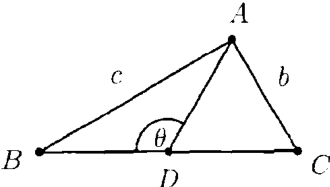
Let ABC be a planar triangle. Let λ≥0. Define the point D(λ) on the side BC so that D(λ) divides BC in the ratio cλ:bλ. Prove that ∣AD(λ)∣≤∣AD(2−λ)∣iffλ≥1.
This one wants a proof. Work it on paper, read the official solution, then mark
yourself honestly — the ladder only means something if the record is true.
Official solution
Let D=D(λ) for a fixed λ and denote θ=∠ADB=180∘−∠CDA. The Cosine Rule for the triangles △DAB and △CAD gives c2b2=∣BD∣2+∣AD∣2−2∣BD∣⋅∣AD∣cosθ=∣DC∣2+∣AD∣2+2∣DC∣⋅∣AD∣cosθ. Eliminating cosθ gives 2∣BD∣⋅∣AD∣∣BD∣2+∣AD∣2−c2=2∣DC∣⋅∣AD∣b2−∣DC∣2−∣AD∣2 from which we obtain ∣AD∣2=∣BD∣+∣DC∣b2∣BD∣+c2∣DC∣−∣BD∣⋅∣DC∣. From ∣BD∣/∣DC∣=cλ/bλ and ∣BD∣+∣DC∣=a we deduce ∣BD∣=cλbλ+cλaand∣DC∣=bλbλ+cλa. Substitution into the previous formula establishes that ∣AD(λ)∣2=(bλ+cλ)2bλcλ((b2−λ+c2−λ)(bλ+cλ)−a2). Hence ∣AD(2−λ)∣2∣AD(λ)∣2=(bλ+cλ)2bλcλb2−λc2−λ(b2−λ+c2−λ)2, so that ∣AD(2−λ)∣∣AD(λ)∣=bλ+cλbλ−1cλ−1(b2−λ+c2−λ)=tλ+1tλ−1(t2−λ+1), where t=b/c. Hence ∣AD(λ)∣≤∣AD(2−λ)∣ iff t+tλ−1≤tλ+1 equivalently iff 0≤1−t+tλ−1(t−1)=(1−t)(1−tλ−1) which holds for t>0 iff λ≥1.
Source: MathNet,
licensed CC-BY-4.0.
Statement and solution reproduced as published; topic, difficulty and ordering added
by this site.