Olympiad Maths Prep

Track / Stage 8 / 131 of 180 #1831 of 2000

Problem 1831

IMO Shortlist mid-range; USAMO P2/P5
Geometry Difficulty 8.5 Prove it Team selection test for 47. IMO · Bulgaria

Problem:
Let kk be the circumcircle of ABC\triangle ABC and DD be a point on the arc \overparenAB\overparen{AB}, which does not contain CC. Denote by IAI_{A} and IBI_{B} the incenters of ADC\triangle ADC and BDC\triangle BDC, respectively. Prove that the circumcircle of IAIBC\triangle I_{A} I_{B} C is tangent to kk if and only if
ADBD=AC+CDBC+CD \frac{AD}{BD} = \frac{AC + CD}{BC + CD}

This one wants a proof. Work it on paper, read the official solution, then mark yourself honestly — the ladder only means something if the record is true.

Official solution

Solution:
Let P=CIAkP = CI_{A} \cap k and Q=CIBkQ = CI_{B} \cap k. First we prove that the circumcircle k1k_{1} of IAIBC\triangle I_{A} I_{B} C is tangent to kk if and only if IAIBPQI_{A} I_{B} \parallel PQ.
Let TT be the point on the tangent line to kk at CC, for which ACT=ABC\angle ACT = \angle ABC. If kk and k1k_{1} are tangent then CTCT is their common tangent line and therefore
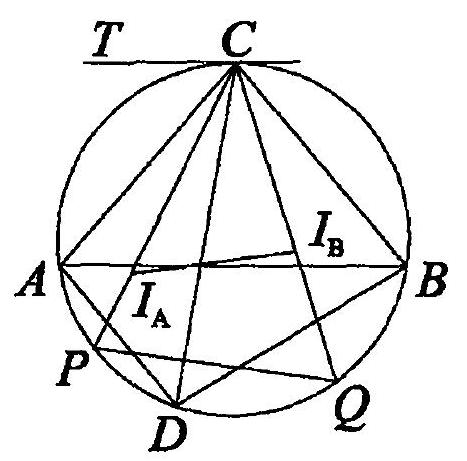
Figure 1

CQP=TCP=TCIA=CIBIA\angle CQP = \angle TCP = \angle TCI_{A} = \angle CI_{B} I_{A},
i.e. IAIBPQI_{A} I_{B} \parallel PQ. Conversely, if IAIBPQI_{A} I_{B} \parallel PQ, then TCIA=TCP=CQP=CIBIA\angle TCI_{A} = \angle TCP = \angle CQP = \angle CI_{B} I_{A}, implying that the line CTCT is tangent to k1k_{1}.

It remains to prove that IAIBPQADBD=AC+CDBC+CDI_{A} I_{B} \parallel PQ \Longleftrightarrow \frac{AD}{BD} = \frac{AC + CD}{BC + CD}.
Since PIA=PA=PDPI_{A} = PA = PD and QIB=QB=QDQI_{B} = QB = QD, we have
IAIBPQCIACIB=APBQAC+CDAD2cosACD2BC+CDBD2cosBCD2=2RABCsinACD22RABCsinBCD2AC+CDADBC+CDBD=sinACDsinBCDAC+CDADBC+CDBD=ADBDAC+CDBC+CD=ADBD \begin{aligned} I_{A} I_{B} \parallel PQ &\Longleftrightarrow \frac{CI_{A}}{CI_{B}} = \frac{AP}{BQ} \\ & \frac{AC + CD - AD}{2 \cos \frac{\angle ACD}{2}} \\ & \Longleftrightarrow \frac{BC + CD - BD}{2 \cos \frac{\angle BCD}{2}} = \frac{2R_{ABC} \sin \frac{\angle ACD}{2}}{2R_{ABC} \sin \frac{\angle BCD}{2}} \\ & \Longleftrightarrow \frac{AC + CD - AD}{BC + CD - BD} = \frac{\sin \angle ACD}{\sin \angle BCD} \\ & \Longleftrightarrow \frac{AC + CD - AD}{BC + CD - BD} = \frac{AD}{BD} \Longleftrightarrow \frac{AC + CD}{BC + CD} = \frac{AD}{BD} \end{aligned}

Source: MathNet, licensed CC-BY-4.0. Statement and solution reproduced as published; topic, difficulty and ordering added by this site.