There were 64 contestants at a chess tournament. Every pair played a game that ended either with one of them winning or in a draw. If a game ended in a draw, then each of the remaining 62 contestants won against at least one of these two contestants. There were at least two games ending in a draw at the tournament. Show that we can line up all the contestants so that each of them has won against the one standing right behind him.
Problem 1808
Official solutions — 2
Solution 1
First, we show that for each contestant at most one game ended in a draw. Assume, to the contrary, that the contestant tied against and . The game between and was tied, so won against at least one of them. The game between and was tied, so won against . On the other hand, the game between and ended in a draw, but did not beat either of them. This contradicts the assumptions of the problem.
The sequence of contestants is called increasing, if for all the contestant lost against . Let be the length of the longest increasing sequence of contestants. If , then we are done. Otherwise, assume that .
Let be the contestant who is not included in the longest increasing sequence . Then did not win against , otherwise would be an increasing sequence of length . Assume that won against . Then and did not tie since lost against both of them. If had won against , then would be an increasing sequence of length . So, won against . Similarly, we conclude that won against . So, is an increasing sequence of length , a contradiction.
Hence, and tied. As tied against at most one opponent, we have and this opponent is . If won against , we can repeat the argument above to show that also won against . So, is an increasing sequence of length 64. We have assumed no such sequence exists, so must have beaten (they did not tie as tied against ). Similarly, we conclude that each of the remaining contestants for has won against . On the other hand, there were two other players, and for , , whose game ended in a draw. This means they both won against . The latter contradicts the assumptions of the problem, which proves that the length of the longest increasing sequence of players is 64.
Solution 2
As in the first solution we show that each participant tied at most once. Let denote a tie. If won, we write . If won, we write . If , then for all other contestants we have either or .
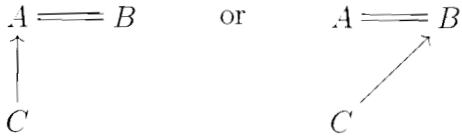
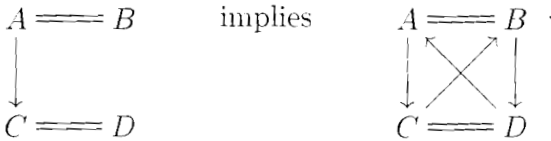
If , and , then . Since , we have , and since , we have .
Assume that games ended in a draw. We use induction to show that the players who tied once can be labeled as in such a way that
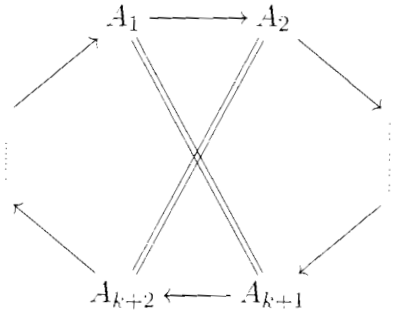
If , denote the 4 players by , . Without loss of generality we may assume that . As we have shown before, we can assign the labels as follows: , , and .
Assume that (1) holds and let us show this in the case of tied games. Let us choose a pair of contestants who tied against one another and denote them by and . The remaining contestants can be labeled so that (1) holds. Furthermore, we may also assume that (otherwise exchange and ). Since , we have . Let be the smallest index, such that . Then . On the other hand, , and . As shown above, this implies .
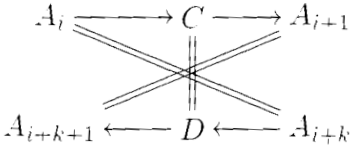
Let for , , for , and for . Then
which is what we wanted to see.