Maths Olympiad Prep

Library / CEMC Fryer /81 of 89

CEMC Fryer, 2022

Geometry Difficulty 4.1 AIME Prove it Canada

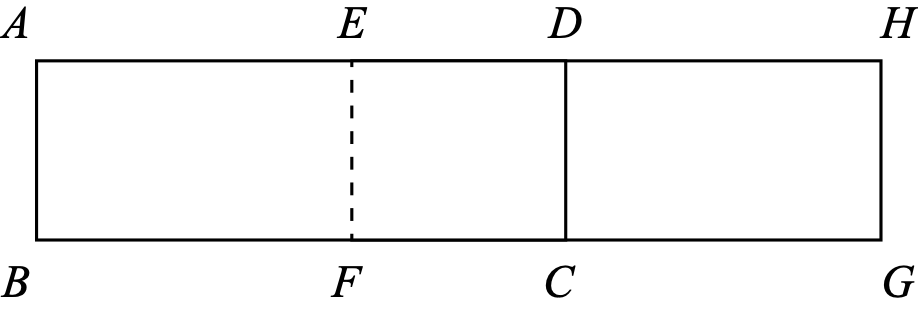
Two identical rectangles, ABCDABCD and EFGHEFGH, each with area 13 cm2^2, overlap as shown.

Figure 0

The area of the
overlapped region, rectangle EFCDEFCD,
is 5 cm2^2. What is the area of
rectangle ABGHABGH?

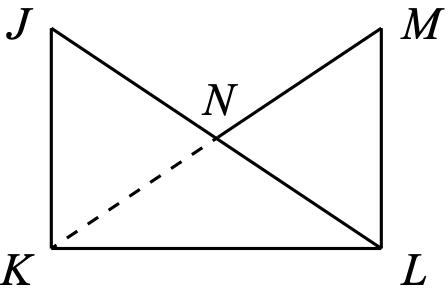
Two identical right-angled triangles,
JKLJKL and MLKMLK, overlap along side KLKL, as shown.

Figure 1

Sides JLJL and MKMK intersect at NN. The area of the overlapped region,
△KLN\triangle KLN, is equal to half of
the area of △JKL\triangle JKL. The area
of the figure JKLMNJKLMN is 48 cm248 \text{ cm}^2. If JK=6JK=6 cm, determine the length of KLKL.

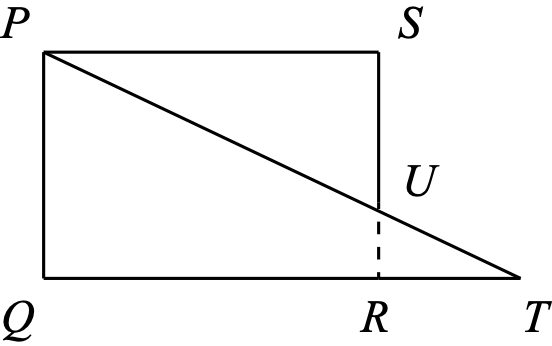
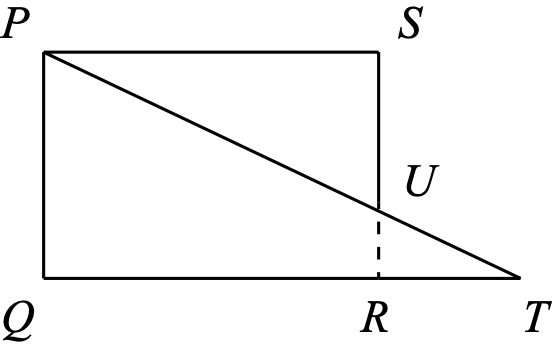
Rectangle PQRSPQRS and △PQT\triangle PQT overlap so that RR lies on QTQT, and RSRS intersects PTPT at UU, as shown.

Figure 2

The area of rectangle PQRSPQRS is 108 cm2^2, and the area of △PQT\triangle PQT is 81 cm2^2. If the area of the figure PQTUSPQTUS is 117 cm2^2, determine the area of the overlapped
region, PQRUPQRU.

Solution

Solution 1

The area of ABGHABGH is equal to the
sum of the areas of ABCDABCD and EFGHEFGH minus the area of overlap EFCDEFCD since it is counted twice in this
sum.

Thus, the area of ABGHABGH is (13 cm2)+(13 cm2)−(5 cm2)=21 cm2(13\textrm{ cm}^2) + (13 \textrm{ cm}^2) - (5 \textrm{ cm}^2)= 21\textrm{ cm}^2.

Solution 2

The area of ABCDABCD is 13 cm2^2 and is equal to the sum of the areas
of ABFEABFE and EFCDEFCD.

Since the area of EFCDEFCD is 5 cm2^2, then the area of ABFEABFE is (13 cm2)−(5 cm2)=8 cm2(13\textrm{ cm}^2) - (5 \textrm{ cm}^2) = 8\textrm{ cm}^2.

The area of ABGHABGH is equal to the
sum of the areas of ABFEABFE and EFGHEFGH or (8 cm2)+(13 cm2)=21 cm2(8\textrm{ cm}^2) + (13 \textrm{ cm}^2) = 21\textrm{ cm}^2.
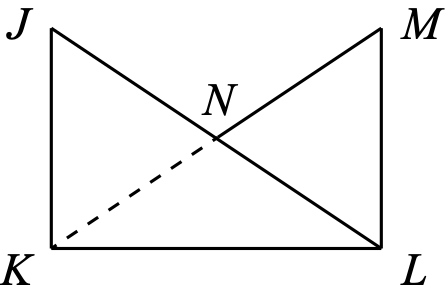
Let the area of the overlapped region, △KLN\triangle KLN, be xx cm2^2.

The area of △KLN\triangle KLN is equal
to half of the area of △JKL\triangle JKL, and so the area of △JKN\triangle JKN is also xx cm2^2.

Since △JKL\triangle JKL and △MLK\triangle MLK are identical, then the
area of △MLN\triangle MLN is also xx cm2^2.

Thus, the area of the figure JKLMNJKLMN
is 3x3x cm2^2, and so 3x=483x=48 or x=16x=16.

Figure 3

Since △JKL\triangle JKL is
right-angled at KK, then its area is
given by 12(JK)(KL)\frac12(JK)(KL).

Since the area of △JKL\triangle JKL is
2x cm2=322x \text{ cm}^2=32 cm2^2, then 12(JK)(KL)=32\frac12(JK)(KL)=32 cm2^2 or 12(6 cm)(KL)=32\frac12(6 \text{ cm})(KL)=32 cm2^2, and so KL=323KL=\frac{32}{3} cm.
We use the notation ∣△URT∣|\triangle URT| to denote the area of
△URT\triangle URT, and similar notation
for other areas.

Since ∣PQRS∣+∣△URT∣=∣PQTUS∣|PQRS|+|\triangle URT|=|PQTUS|, then ∣△URT∣=∣PQTUS∣−∣PQRS∣=117 cm2−108 cm2=9 cm2.|\triangle URT|=|PQTUS|-|PQRS|=117 \text{ cm}^2 - 108 \text{ cm}^2=9 \text{ cm}^2. Since ∣PQRU∣+∣△URT∣=∣△PQT∣|PQRU|+|\triangle URT|=|\triangle PQT|, then ∣PQRU∣=∣△PQT∣−∣△URT∣=81 cm2−9 cm2=72 cm2.|PQRU|=|\triangle PQT|-|\triangle URT|=81 \text{ cm}^2 - 9 \text{ cm}^2=72 \text{ cm}^2.

Figure 4

Want a route through all this instead of an archive? The track puts 2,604 problems in a working order, from Junior Challenge level to the IMO shortlist.

Source: CEMC, University of Waterloo, licensed CC-BY-NC-4.0. Statement reproduced verbatim; metadata (topic, difficulty) added by this project.