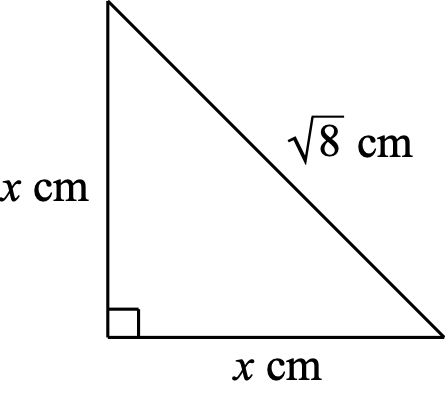
In the diagram, the right-angled isosceles triangle has a
hypotenuse length of .
What is the smallest number of these triangles needed to completely
cover a square with side length ?
In the diagram, the right-angled isosceles triangle has a
hypotenuse length of .
What is the smallest number of these triangles needed to completely
cover a square with side length ?
Pick one
Using the Pythagorean Theorem, we get or . So, or (since ).
Thus, the right-angled isosceles triangle has area .
A square with side length has area .
Thus, the smallest number of these triangles needed to completely cover
the square is .