If is a positive integer, the notation (read “ factorial”) is used to represent the product of the integers from 1 to inclusive. For example, . Which of the following is equal to a perfect square?
CEMC Gauss (Grade 8), 2019
Pick one
Solution
Begin by constructing perpendicular to and perpendicular to .
The four segments , and divide into 9 identical squares.
Label the intersections of the perpendicular pairs of these four segments as points , and .
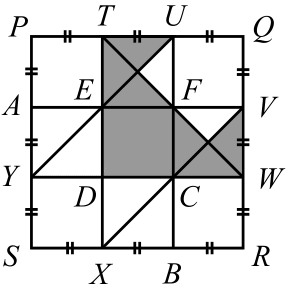
lies on such that . lies on such that . is the intersection of segments and . is the intersection of segments and . is the intersection of segments and . is the intersection of and .
Segment is a diagonal of square and so passes through , the centre of square .
Segment is a diagonal of square .
Segment is a diagonal of square and is a diagonal of square .
The diagonals in any square divide the square into 4 identical triangles.
For example, the diagonals and divide the square into 4 identical triangles, 3 of which are shaded.
Similarly, we can show that diagonals and divide square into 4 identical triangles, 3 of which are shaded.
We may construct the missing diagonals in each of the 9 squares.
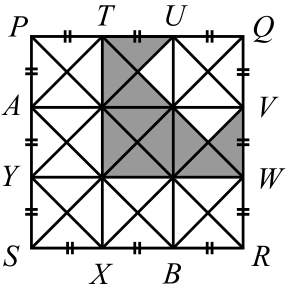
These diagonals divide square into identical triangles.
Since 10 of these triangles are shaded, then of square is shaded.
Want a route through all this instead of an archive? The track
puts 2,604 problems in a working order, from Junior Challenge level to the IMO shortlist.