Trapezoid ABCD is drawn, as shown.
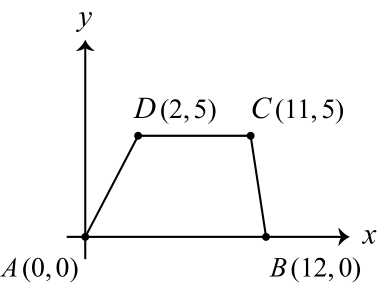
The slope of line segments AB and CD are each zero and thus they are parallel.
The length of AB is the difference between the x-coordinates of A and B, or 12.
The length of CD is the difference between the x-coordinates of C and D, or 11−2=9.
The height of the trapezoid is equal to the vertical distance between AB and CD, which is 5.
The area of trapezoid ABCD is 25(AB+CD) or 25(21)=2105.
The line passing through B and D intersects the y-axis at E. Let the coordinates of E be (0,e), as shown.
The slope of the line through B and D is 2−125−0=−21.
Solution 1
Since E,D and B lie on the same line, then the slope of ED is equal to the slope of BD.
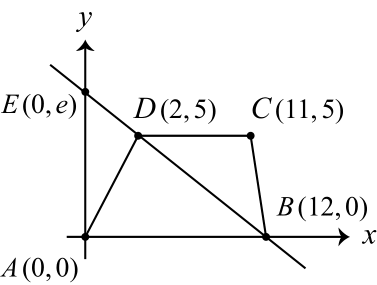
Equating slopes, we get 0−2e−5=−21 or 2e−5=21, and so e−5=1 or e=6.
Thus, point E has coordinates (0,6).
Solution 2
The line passing through B(12,0) and D(2,5) has slope −21, and thus has equation y−5=−21(x−2).
Rearranging, we get y−5=−21x+1 or y=−21x+6.
Since this line has y-intercept 6, then point E has coordinates (0,6).
Solution 3
The line passing through B(12,0) and D(2,5) has slope −21, and thus has equation y−5=−21(x−2).
This line passes through E(0,e), and so e−5=−21(0−2) or e=1+5=6.
Thus, point E has coordinates (0,6).
Sides AD and BC are extended to intersect at F, as shown.
Solution 1
Let the coordinates of F be (j,k).
Since A,D and F lie on the same line, then the slope of AD is equal to the slope of AF.
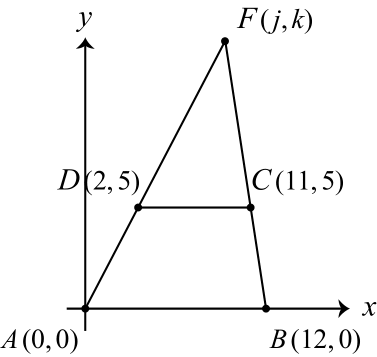
Equating slopes, we get 25=jk or k=25j.
Since B,C and F lie on the same line, then the slope of BC is equal to the slope of BF.
Equating slopes, we get 11−125−0=j−12k−0 or −5=j−12k, and so k=−5(j−12).
Substituting k=25j, we get 25j=−5(j−12) or j=−2(j−12), and so 3j=24 or j=8.
When j=8, k=25(8)=20, and so F has coordinates (8,20).
Solution 2
The line passing through A(0,0) and D(2,5) has slope 25 and y-intercept 0, and thus has equation y=25x.
The line passing through B(12,0) and C(11,5) has slope −5 and thus has equation y=−5(x−12).
These two lines intersect at F, and so the coordinates of F can be determined by solving the equation 25x=−5(x−12). Solving, we get x=−2(x−12) or 3x=24, and so x=8.
When x=8, y=25(8)=20, and so F has coordinates (8,20).
Let P have coordinates (r,s).
Assume AB is the base of △PAB.
In this case, if the height of △PAB is h, then the area of △PAB is 21(AB)h=6h.
The area of △PAB is 42, and so 6h=42 or h=7.
That is, P(r,s) is located a vertical distance of 7 units from the line through A and B, or 7 units from the x-axis.
There are two possibilities: P(r,s) is located 7 units above the x-axis, and thus lies on the horizontal line y=7, or P(r,s) is located 7 units below the x-axis, and thus lies on the horizontal line y=−7.
In the first case, P has coordinates (r,7) and in the second case, P has coordinates (r,−7).
Recall that P lies on the line passing through B and D.
The line passing through B(12,0) and D(2,5) has slope −21, and thus has equation y−5=−21(x−2).
If P(r,7) lies on this line, then 7−5=−21(r−2) or −4=r−2, and so r=−2.
Similarly, if P(r,−7) lies on this line, then −7−5=−21(r−2) or 24=r−2, and so in this case, r=26.
The points P that lie on the line passing through B and D, so that the area of △PAB is 42, are (−2,7) and (26,−7).