In the diagram, , , , , and represent five consecutive integers, not necessarily in order.
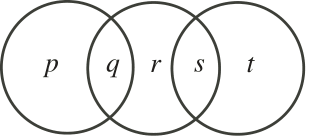
The two integers in the leftmost circle add to 63. The two integers in the rightmost circle add to 57. What is the value of ?
In the diagram, , , , , and represent five consecutive integers, not necessarily in order.
The two integers in the leftmost circle add to 63. The two integers in the rightmost circle add to 57. What is the value of ?
Pick one
Solution 1
Suppose that the five consecutive integers represented by are , for some integer .
The sum of any two of these integers is at most ; the sum of every other pair is smaller.
The sum of any two of these integers is at least ; the sum of every other pair is larger.
Therefore, the maximum possible difference between the sums of two pairs is or ; any other choice of pairs will give a smaller difference between the sums.
Since we are told that and , which gives , then it must be the case that and are the two largest integers from the list while and are the two smallest integers from the list.
In other words, and so or and so .
Since must be the middle integer in the list, then .
Solution 2
Suppose that the five consecutive integers represented by are , for some integer .
The sum of all five integers is .
We are told that and .
Thus, the sum of the five integers is also .
Comparing the two expressions for the sum of the integers, we obtain or .
Since , then is divisible by 5.
Of the five given answer choices, this means that we could have or .
If , then or and so . In this case, is not one of the integers between and , inclusive, so cannot be 20.
If , then or and so . Here, the integers in the list would be , which can produce the given conditions if and are and , and and are 28 and 29.
Therefore, .