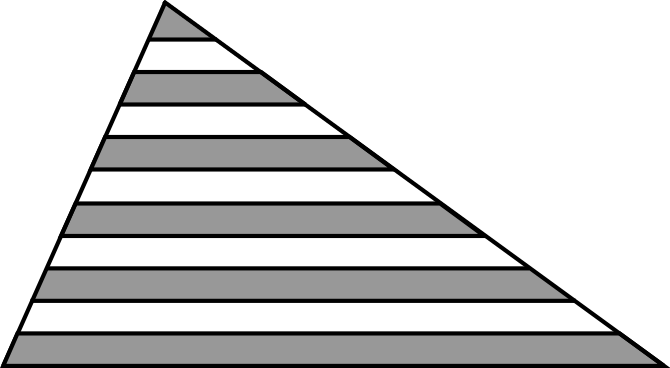
A triangle of area 770 cm2 is divided into 11 regions of equal height by 10 lines that are all parallel to the base of the triangle. Starting from the top of the triangle, every other region is shaded, as shown.
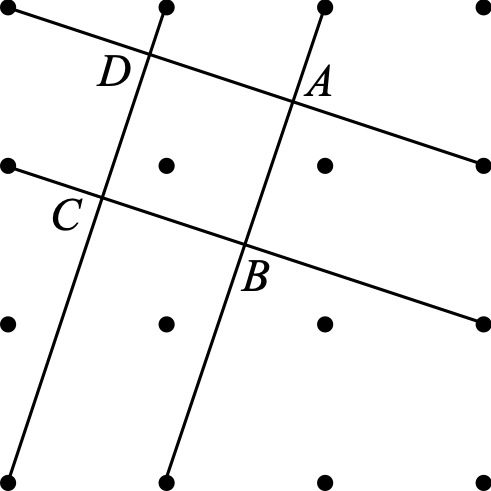
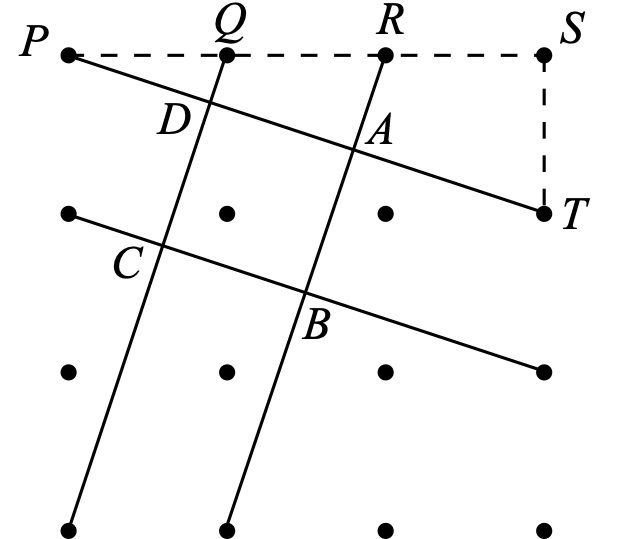
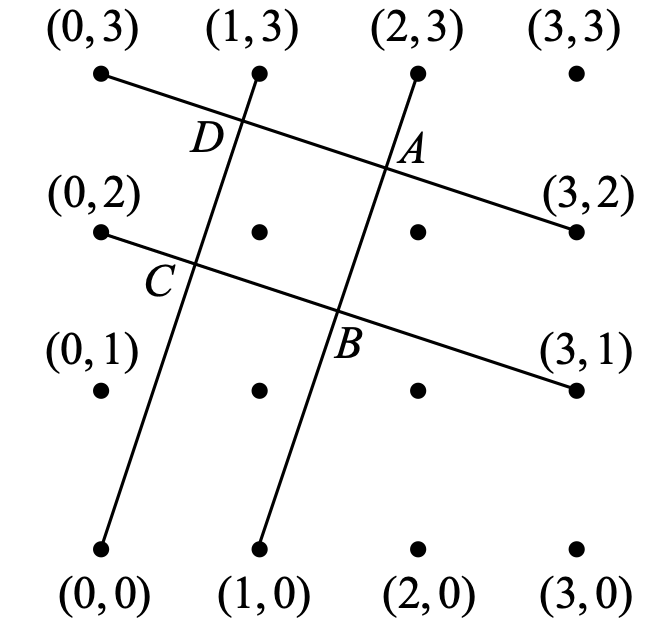
What is the total area of the shaded regions? A square lattice of 16 points is constructed such that the horizontal and vertical distances between adjacent points are all exactly 1 unit. Each of four pairs of points are connected by a line segment, as shown.
The intersections of these line segments are the vertices of square ABCD. Determine the area of square ABCD.
Solution
Solution 1
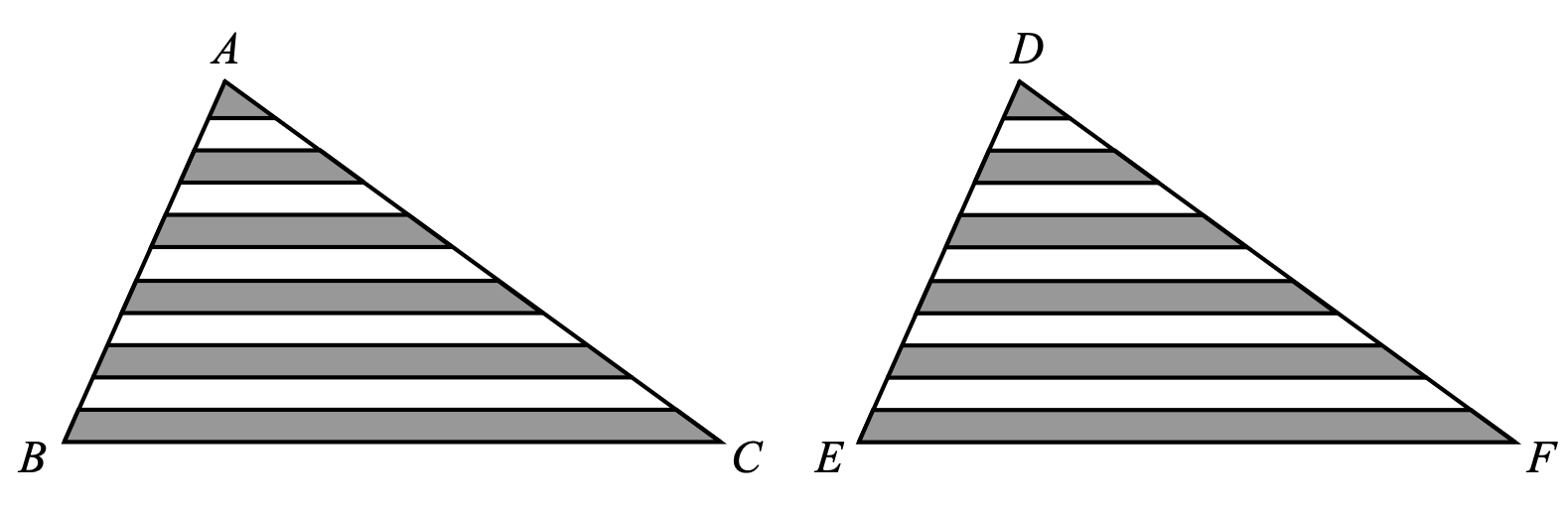
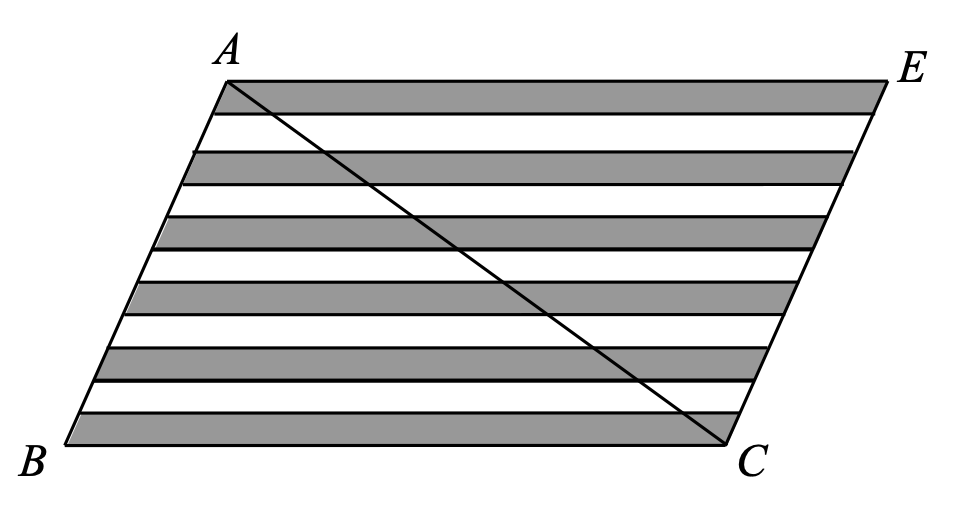
We make two copies of the given triangle, labelling them △ABC and △DEF, as shown:
The combined area of these two triangles is 2⋅770 cm2=1540 cm2, and the shaded area in each triangle is the same.
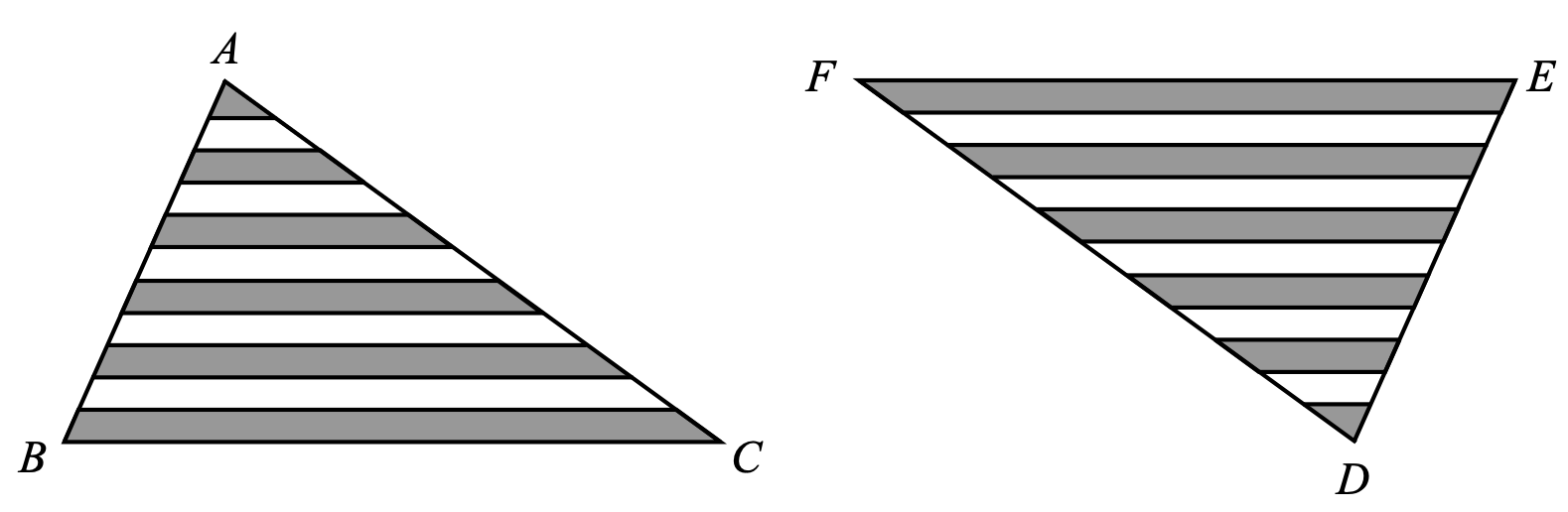
Next, we rotate △DEF by 180∘:
and join the two triangles together:
We note that BC and AE (which was FE) are equal in length (since they were copies of each other) and parallel (since they are 180∘ rotations of each other). The same is true for AB and EC.
Therefore, ABCE is a parallelogram.
Further, ABCE is divided into 11 identical parallelograms (6 shaded and 5 unshaded) by the horizontal lines. (Since the sections of the two triangles are equal in height, the horizontal lines on both sides of AC align.)
The total area of parallelogram ABCE is 1540 cm2.
Thus, the shaded area of ABCE is 116⋅1540 cm2=840 cm2.
Since this shaded area is equally divided between the two halves of the parallelogram, then the combined area of the shaded regions of △ABC is 21⋅840 cm2=420 cm2.
Solution 2
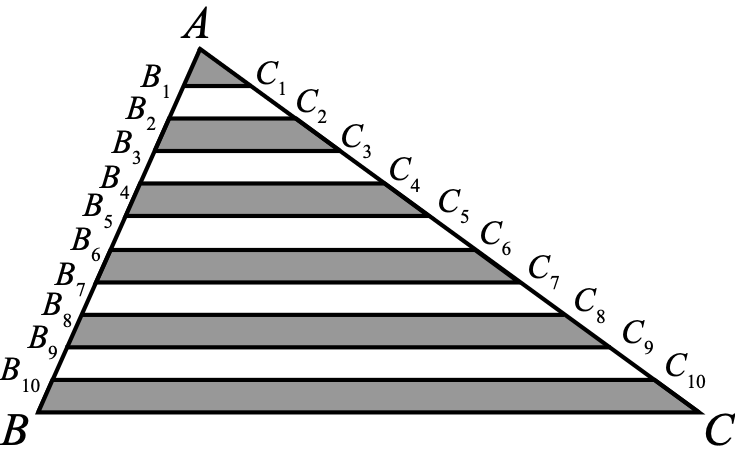
We label the points where the horizontal lines touch AB and AC as shown:
We use the notation ∣△ABC∣ to represent the area of △ABC and use similar notation for the area of other triangles and quadrilaterals.
Let A be equal to the total area of the shaded regions.
Thus, A=∣△AB1C1∣+∣B2B3C3C2∣+∣B4B5C5C4∣+∣B6B7C7C6∣+∣B8B9C9C8∣+∣B10BCC10∣ The area of each of these quadrilaterals is equal to the difference of the area of two triangles. For example, ∣B2B3C3C2∣=∣△AB3C3∣−∣△AB2C2∣=−∣△AB2C2∣+∣△AB3C3∣ Therefore, Aamp;=∣△AB1C1∣−∣△AB2C2∣+∣△AB3C3∣−∣△AB4C4∣+∣△AB5C5∣amp;−∣△AB6C6∣+∣△AB7C7∣−∣△AB8C8∣+∣△AB9C9∣−∣△AB10C10∣+∣△ABC∣ Each of △AB1C1, △AB2C2, …, △AB10C10 is similar to △ABC because their two base angles are equal due.
Suppose that the height of △ABC from A to BC is h.
Since the height of each of the 11 regions is equal in height, then the height of △AB1C1 is 111h, the height of △AB2C2 is 112h, and so on.
When two triangles are similar, their heights are in the same ratio as their side lengths:
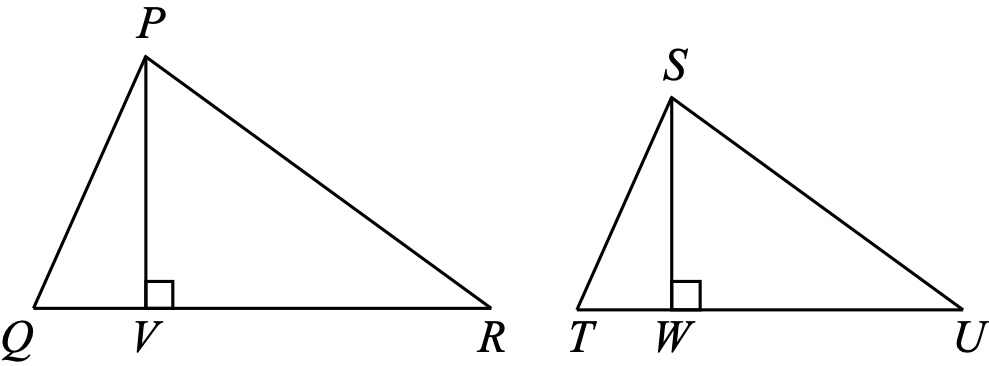
To see this, suppose that △PQR is similar to △STU and that altitudes are drawn from P and S to V and W.
Since ∠PQR=∠STU, then △PQV is similar to △STW (equal angle; right angle), which means that STPQ=SWPV. In other words, the ratio of sides is equal to the ratio of heights.
Since the height of △AB1C1 is 111h, then B1C1=111BC.
Therefore, Aamp;=11212∣△ABC∣−11222∣△ABC∣+11232∣△ABC∣−11242∣△ABC∣+11252∣△ABC∣amp;−11262∣△ABC∣+11272∣△ABC∣−11282∣△ABC∣+11292∣△ABC∣−112102∣△ABC∣+112112∣△ABC∣amp;=1121∣△ABC∣(112−102+92−82+72−62+52−42+32−22+1)amp;=1121(770 cm2)((11+10)(11−10)+(9+8)(9−8)+⋯+(3+2)(3−2)+1)amp;=1121(770 cm2)(11+10+9+8+7+6+5+4+3+2+1)amp;=111(70 cm2)⋅66amp;=420 cm2 Therefore, the combined area of the shaded regions of △ABC is 420 cm2. Solution 1
We label five additional points in the diagram:
Since PQ=QR=RS=1, then PS=3 and PR=2.
Since ∠PST=90∘, then PT=PS2+ST2=32+12=10 by the Pythagorean Theorem.
We are told that ABCD is a square.
Thus, PT is perpendicular to QC and to RB.
Thus, △PDQ is right-angled at D and △PAR is right-angled at A.
Since △PDQ, △PAR and △PST are all right-angled and all share an angle at P, then these three triangles are similar.
This tells us that PSPA=PTPR and so PA=103⋅2. Also, PSPD=PTPQ and so PD=101⋅3.
Therefore, DA=PA−PD=106−103=103 This means that the area of square ABCD is equal to DA2=(103)2=109.
Solution 2
We add coordinates to the diagram as shown:
We determine the side length of square ABCD by determining the coordinates of D and A and then calculating the distance between these points.
The slope of the line through (0,3) and (3,2) is 0−33−2=−31.
This equation of this line can be written as y=−31x+3.
The slope of the line through (0,0) and (1,3) is 3.
The equation of this line can be written as y=3x.
The slope of the line through (1,0) and (2,3) is also 3.
The equation of this line can be written as y=3(x−1)=3x−3.
Point D is the intersection point of the lines with equations y=−31x+3 and y=3x.
Equating expressions for y, we obtain −31x+3=3x and so 310x=3 which gives x=109.
Since y=3x, we get y=1027 and so the coordinates of D are (109,1027).
Point A is the intersection point of the lines with equations y=−31x+3 and y=3x−3.
Equating expressions for y, we obtain −31x+3=3x−3 and so 310x=6 which gives x=1018.
Since y=3x−3, we get y=1024 and so the coordinates of A are (1018,1024). (It is easier to not reduce these fractions.)
Therefore, DA=(109−1018)2+(1027−1024)2=(−109)2+(103)2=10090=109 This means that the area of square ABCD is equal to DA2=(109)2=109.
Want a route through all this instead of an archive? The track
puts 2,604 problems in a working order, from Junior Challenge level to the IMO shortlist.