Maths Olympiad Prep

Library / CEMC Fryer /53 of 89

CEMC Fryer, 2011

Geometry Difficulty 3.0 AMC 10/12 Prove it Canada

In any isosceles triangle ABCABC with AB=ACAB = AC, the altitude ADAD bisects the base BCBC so that BD=DCBD = DC.

(a) (i) As shown in △ABC\triangle ABC, AB=AC=25AB = AC = 25 and BC=14BC = 14. Determine the length of the altitude ADAD.

(ii) Determine the area of △ABC\triangle ABC.

(b) Triangle ABCABC from part (a) is cut along its altitude from AA to DD (Figure 1). Each of the two new triangles is then rotated 90∘90^\circ about point DD until BB meets CC directly below DD (Figure 2). This process creates the new triangle which is labelled PQRPQR (Figure 3).

(i) In △PQR\triangle PQR, determine the length of the base PRPR.

(ii) Determine the area of △PQR\triangle PQR.

(c) There are two different isosceles triangles whose side lengths are integers and whose areas are 120. One of these two triangles, △XYZ\triangle XYZ, is shown. Determine the lengths of the three sides of the second triangle.
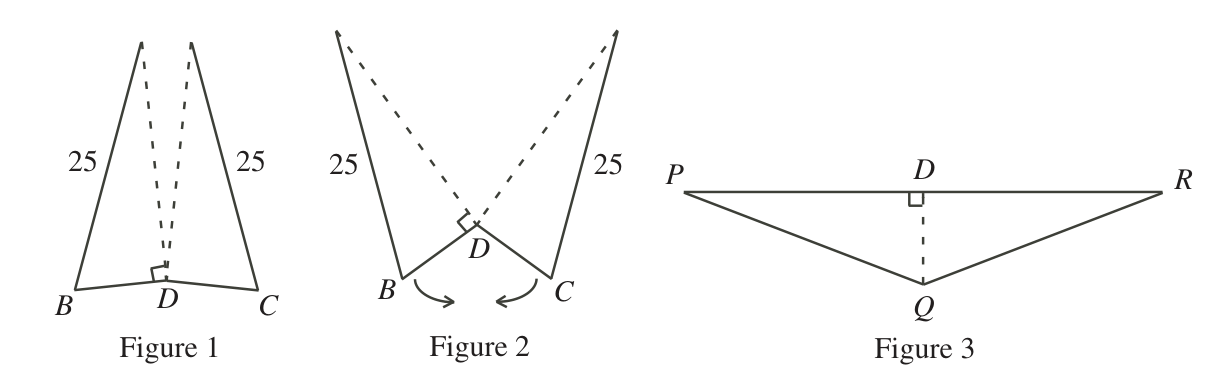
Figure for this problem

We don't reproduce this publisher's solutions. Their own solution is here — work the problem first.
Want a route through all this instead of an archive? The track puts 2,604 problems in a working order, from Junior Challenge level to the IMO shortlist.

Source: CEMC, University of Waterloo, licensed CC-BY-NC-4.0. Statement reproduced verbatim; metadata (topic, difficulty) added by this project. Solutions are the publisher's, linked not copied.