The sum of the units column is P+P+P=3P.
Since P is a single digit, and 3P ends in a 7, then the only possibility is P=9.
This gives:
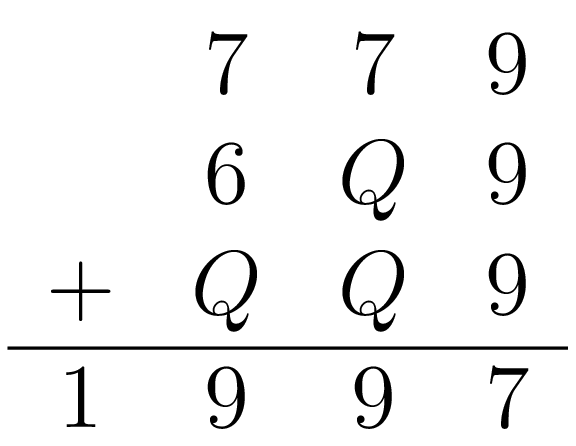
Then 3P=3×9=27, and thus 2 is carried to the tens column.
The sum of the tens column becomes 2+7+Q+Q or 9+2Q.
Since 9+2Q ends in a 9 (since P=9), then 2Q ends in 9−9=0.
Since Q is a single digit, there are two possibilities for Q such that 2Q ends in 0.
These are Q=0 and Q=5.
If Q=0, then the sum of the tens column is 9 with no carry to the hundreds column.
In this case, the sum of the hundreds column is 7+6+Q or 13 (since Q=0); the units digit of this sum does not match the 9 in the total.
Thus, we conclude that Q cannot equal 0 and thus must equal 5.
Verifying that Q=5, we check the sum of the tens column again.
Since 2+7+5+5=19, then 1 is carried to the hundreds column.
The sum of the hundreds column is 1+7+6+5=19, as required.
Thus, P+Q=9+5=14 and the completed addition is shown below.