Since the average of 31
temperatures was −20°C, then the sum of these
31 temperatures was 31⋅(−20°C)=−620°C.
Since the average of 21 of these
temperatures was −15°C, then the sum of these
21 temperatures was 21⋅(−15°C)=−315°C.
This means that the sum of the other 10 temperatures was −620°C−(−315°C)=−305°C, and so the average of these other 10 temperatures was 10−305°C or −30.5°C.
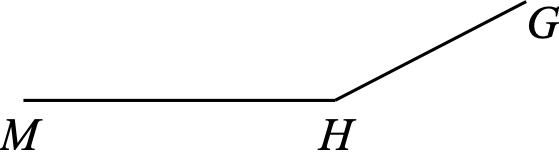
Suppose that MH=x km. This means that HG=(10−x) km.
Since McKayla runs on flat ground at 12 km/h, then the time that it takes her to run from M to H is 12 km/hx km or
12x h.
Since McKayla runs uphill at 10 km/h, then the time that it takes her to run from H to G is 10 km/h(10−x) km
or 1010−x h.
Since it takes her 54 minutes to
run from M to H to G, and 54 minutes is the same as 109 h, then 12x+1010−x=109.
Multiplying both sides of this equation by 120, we obtain 10x+12(10−x)=9⋅12 and so 2x=12 or x=6.
Therefore, to run from G to H to M, it takes McKayla 15 km/h4 km+12 km/h6 km=6016 h+6030 h=6046 h or 46 minutes.