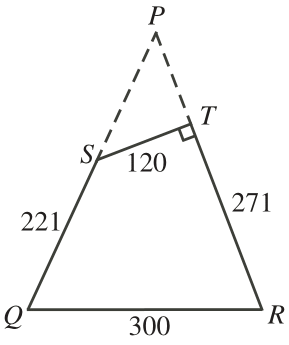
Point S is on PQ and T is on PR so that ST is perpendicular to PR, ST=120, TR=271, and QS=221. The area of quadrilateral STRQ is
Pick one
Solution
We calculate the area of quadrilateral STRQ by subtracting the area of △PTS from the area of △PQR.
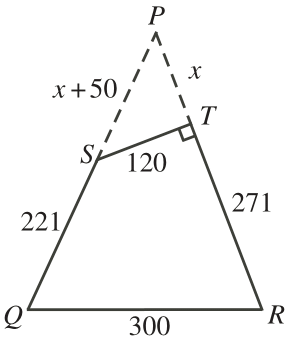
Let PT=x.
Then PR=PT+TR=x+271.
Since PQ=PR=x+271 and SQ=221, then PS=PQ−SQ=(x+271)−221=x+50.
By the Pythagorean Theorem in △PTS, we have PT2+TS2x2+1202x2+1440011900xamp;=PS2amp;=(x+50)2amp;=x2+100x+2500amp;=100xamp;=119 Therefore, △PTS has PT=x=119, TS=120, and PS=x+50=169.
Since △PTS is right-angled at T, then its area is 21(PT)(TS)=21(119)(120)=7140.
Furthermore, in △PQR, we have PR=PQ=x+271=390.
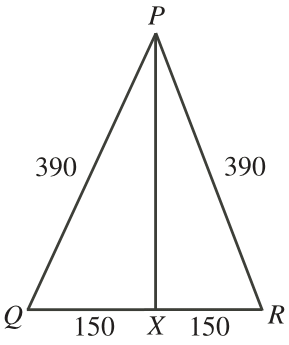
Now, △PQR is isosceles, so when we draw a median PX from P to the midpoint X of QR, it is perpendicular to QR.
Since X is the midpoint of QR and QR=300, then QX=21QR=150.
We can use the Pythagorean Theorem in △PXQ to conclude that PX=PQ2−QX2=3902−1502=21600=360 since PX gt;0.
Since PX is a height in △PQR, then the area of △PQR is 21(QR)(PX)=21(300)(360)=54000.
Finally, the area of STRQ is the difference in the areas of these two triangles, or 54000−7140, which equals 46860.
Want a route through all this instead of an archive? The track
puts 2,604 problems in a working order, from Junior Challenge level to the IMO shortlist.