Solution 1:
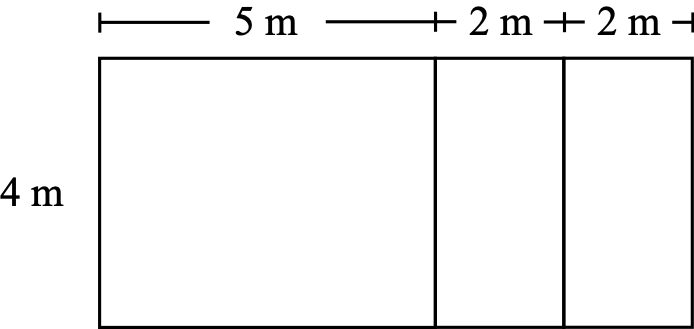
The length of the expanded garden is (5+2×2) m=9 m, and the
width is 4 m.
Thus, the total area of the expanded garden is 9 m×4 m=36 m2.
Solution 2:
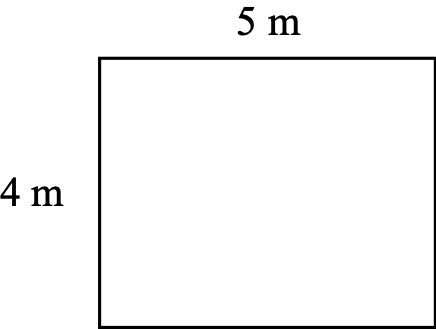
The area of the original 5 m by 4 m garden
is 5 m×4 m=20 m2.
Each additional 2 m by
4 m plot has area 2 m×4 m=8 m2,
and so the total area of the expanded garden is (20+2×8) m2=36 m2.
Solution 1:
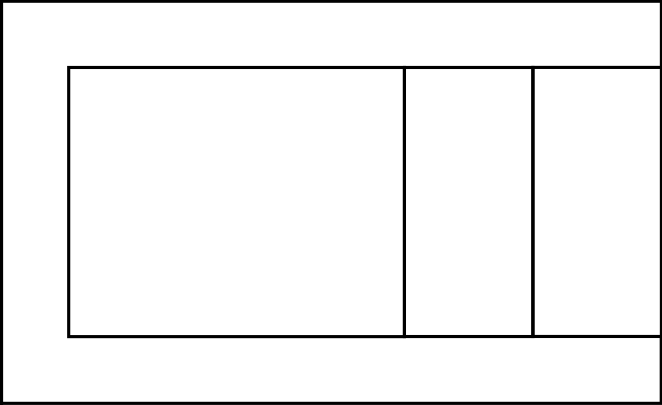
The combined garden and path has length 9 m+1 m=10 m, and
width (4+2×1) m=6 m.
Thus, the area of the garden and the path is 10 m×6 m=60 m2.
Solution 2:
Consider splitting the path into three rectangles, as shown.
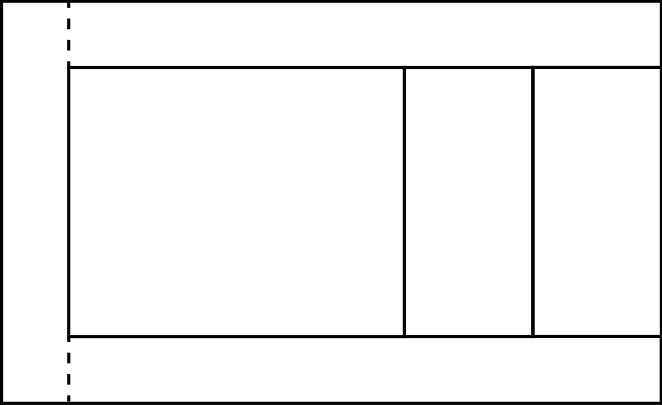
Each of the rectangles above and below the garden has dimensions
9 m by 1 m, and thus each has area 9 m×1 m=9 m2.
The remaining section of the path has height(4+2×1) m=6 m and
width 1 m, and thus has area
6 m×1 m=6 m2. The area of the expanded garden is 36 m2, and so the total combined area of the
garden and the path is (36+2×9+6) m2=60 m2.
Solution 1:
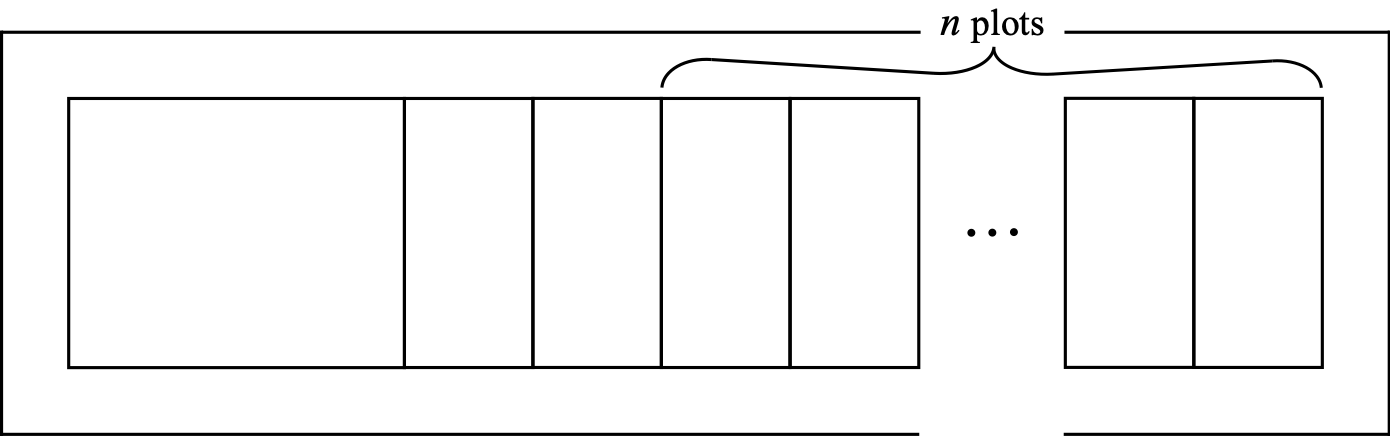
Each of the new plots has length 2 m, and so n plots
increase the 9 m length of
the garden by 2n m.
Thus, the combined length of the garden and the path is (9+2n+2×1) m=(2n+11) m. The combined width of the garden and the path is (4+2×1) m=6 m.
Thus in m2, the total
combined area of the garden and the path is 6×(2n+11).
Solving 6×(2n+11)=150, we get
2n+11=6150=25 or 2n=14, and so n=7.
Solution 2:
Consider splitting the combined area of the garden and path into
three rectangles, as shown.
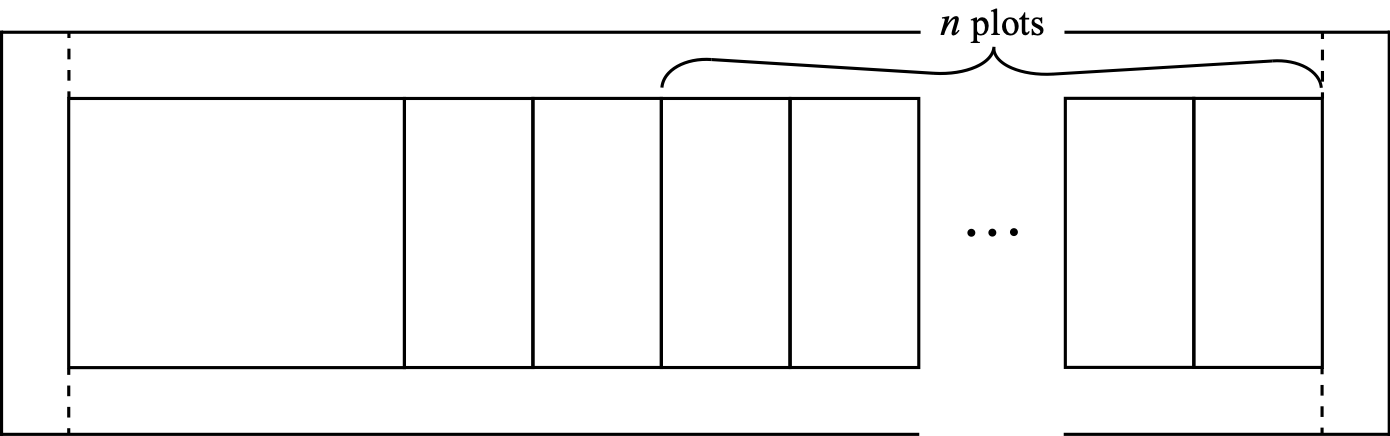
Each of the rectangles to the left and right of the garden has height
(4+2×1) m=6 m,
width 1 m, and thus each has
area 6 m×1 m=6 m2.
The remaining rectangle, which combines the garden and the remaining
sections of the path, also has height 6 m.
Each of the new plots has length 2 m, and so n plots
increase the 9 m length of
the garden by 2n m.
Thus, the length of this remaining rectangle is (2n+9) m.
Measured in m2, the total
combined area of the garden and the path is 2×6+6×(2n+9) or 12+6×(2n+9).
Solving 12+6×(2n+9)=150, we
get 6×(2n+9)=138 or 2n+9=6138=23 or 2n=14, and so n=7.