In the diagram, six squares have a percentage of their area shaded.
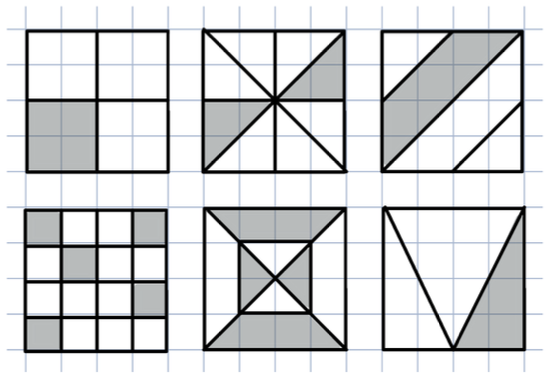
How many of
the squares have exactly
of their area shaded?
In the diagram, six squares have a percentage of their area shaded.
How many of
the squares have exactly
of their area shaded?
Pick one
The top-left square is divided into regions having equal area. Since of these regions is shaded, then of the square is shaded.
The top-middle square is divided into regions having equal area. Since of these regions are shaded, then of the square is shaded.
The top-right square is divided into larger regions having equal areas, and
smaller regions having equal
areas. Since of the larger
regions is shaded, then more than of the square is shaded.
Alternatively, the shaded region consists of three complete squares together with half squares, and thus the shaded
area is . The entire square has area , and is not equivalent to .
The bottom-left square is divided into regions having equal area. Since of these regions are shaded, then more than
of the square is shaded.
The bottom-middle square is divided into larger regions having equal areas, and
smaller regions having equal
areas. Since of the larger regions are shaded, and of the smaller regions are shaded, then of the square is shaded.
In the bottom-right square, consider constructing a vertical line
segment between the midpoint of the top side of the square and the
midpoint of the bottom side of the square. The square would then be
divided into regions having equal
areas. Since of these regions is
shaded, then of the square is
shaded.
Thus, the top-left, top-middle, and bottom-right squares have exactly
of their area shaded and so
there are such squares.