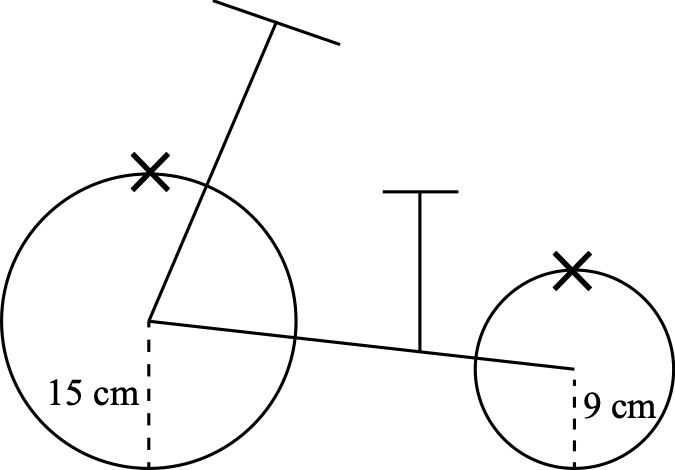
Terry’s bicycle has a larger front wheel with radius 15 cm and a smaller rear wheel with radius 9 cm, as shown.
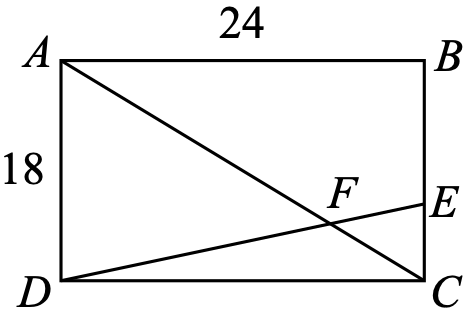
Terry ties a ribbon to the top of each wheel, and then starts to ride forward. Terry travels d cm forward and stops. Both ribbons are again at the top of the wheels. What is the integer closest to the smallest possible value of d with d gt;0? In the diagram, ABCD is a rectangle with AB=24 and AD=18. Also, E is on BC with EC=6. If segments DE and AC intersect at F, determine the length of CF.
Solution
When a wheel on a bicycle makes 1 complete revolution, the bicycle moves a distance forward equal to the circumference of the wheel.
The front wheel on Terry’s bicycle has a radius of 15 cm, so its circumference is 2π⋅(15 cm)=30π cm.
The rear wheel on Terry’s bicycle has a radius of 9 cm, so its circumference is equal to 2π⋅(9 cm)=18π cm.
After 1 complete revolution of the front wheel, the total number of revolutions of the rear wheel is not a whole number, since 30π is not an integer multiple of 18π.
After 2 complete revolutions of the front wheel, the total number of revolutions of the rear wheel is not a whole number, since 60π is not an integer multiple of 18π.
After 3 complete revolutions of the front wheel, the rear wheel will have made 5 complete revolutions, since 90π=5⋅18π. (Note that 90 is the least common multiple of 30 and 18.)
Therefore, after Terry has travelled 90π cm, both wheels have made a whole number of revolutions for the first time.
Thus, the smallest possible value of d is d=90π≈282.7 which means that the integer closest to the smallest possible value of d is 283. Solution 1:
Since ABCD is a rectangle, then DC=AB=24 and ∠ADC=90°.
By the Pythagorean Theorem, AC2=AD2+DC2=182+242=324+576=900.
Since AC gt;0, then AC=900=30.
Consider △ADF and △CEF.
Since AD is parallel to BC, then ∠DAF=∠ECF and ∠ADF=∠CEF.
This means that △ADF and △CEF are similar.
Since AD=18 and CE=6, then AFCF=ADCE=186.
This means that CF:AF=1:3.
Since AC=CF+AF=30, then CF=41AC=430=215.
Solution 2:
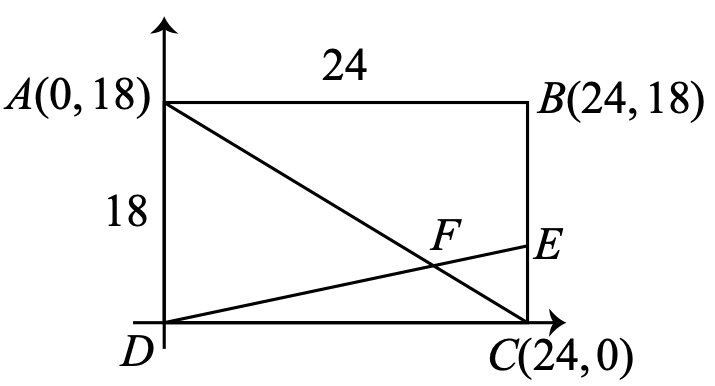
We put the diagram on a coordinate grid with D at the origin (0,0), A on the positive y-axis, and C on the positive x-axis.
Since AD=18, then A has coordinates (0,18).
Since DC=AB=24, then C has coordinates (24,0).
Since BC is vertical and EC=6, then E has coordinates (24,6).
Line segment DE passes through the origin and through (24,6) and so has slope 246 which means that its equation is y=41x.
Line segment AC passes through the points (0,18) and (24,0).
Its slope is thus 0−2418−0=−43, which means that its equation is y=−43x+18.
Point F is the point of intersection of line segments AC and DE.
Equating expressions for y, we obtain 41x=−43x+18, which gives x=18.
Substituting into y=41x, we obtain y=418=29.
Thus, F has coordinates (18,29).
Finally, CF=(24−18)2+(0−29)2=36+481=4225 and so CF=215.
Want a route through all this instead of an archive? The track
puts 2,604 problems in a working order, from Junior Challenge level to the IMO shortlist.