A list of rational numbers is
defined so that if one term is equal to , then the next term is equal to . For example, if , then . If , what is the value of
?
A hollow cylindrical tube has a radius of 10 mm and a
height of 100 mm. The tube sits flat on one of its circular faces on a
horizontal table. The tube is filled with water to a depth of mm. A solid cylindrical rod has a
radius of 2.5 mm and a height of 150 mm. The rod is inserted into the
tube so that one of its circular faces sits flat on the bottom of the
tube. The height of the water in the tube is now 64 mm. Determine the
value of .
CEMC Euclid, 2022
Solution
If is a term in the
sequence and is the next term,
then .
This means that and so which gives .
Therefore, since , then Further, since , then
Initially, the water in the hollow tube forms a cylinder with
radius 10 mm and height mm. Thus,
the volume of the water is .
After the rod is inserted, the level of the water rises to 64 mm. Note
that this does not overflow the tube, since the tube’s height is 100
mm.
Up to the height of the water, the tube is a cylinder with radius 10 mm
and height 64 mm.
Thus, the volume of the tube up to the height of the water is This volume consists of the water that is
in the tube (whose volume, which has not changed, is ) and the rod up to
a height of 64 mm.
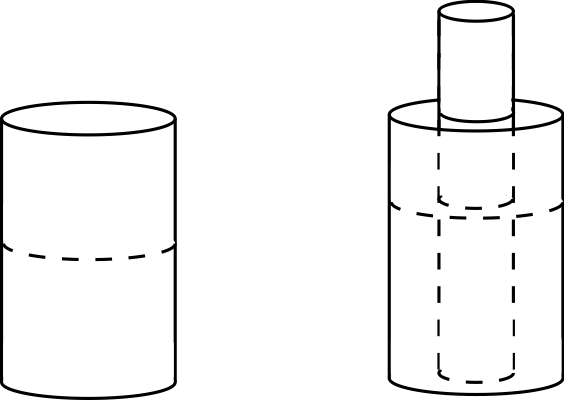
Since the radius of the rod is 2.5 mm, the volume of the rod up to a
height of 64 mm is .
Comparing volumes, and so which gives .
Want a route through all this instead of an archive? The track
puts 2,604 problems in a working order, from Junior Challenge level to the IMO shortlist.