Maths Olympiad Prep

Library / /169 of 187

, 2024

Number theory Difficulty 3.2 AMC 10/12 Prove it Canada

There are MM integers between 1000010\,000 and 100000100\,000 that are multiples of 2121 and whose units (ones) digit is 11. What is the value of MM?
There are NN students who attend Strickland S.S.,
where 500 lt; N lt; 600\text{500 lt; N lt; 600}. Among
these NN students, 25\frac{2}{5} are in the physics club and
14\frac{1}{4} are in the math club.
In the physics club, there are 22
times as many students who are not in the math club as there are
students who are in the math club. Determine the number of students who
are not in either club.

Figure for this problem

Figure for this problem

Solution

Suppose that the length of the track is 2L m2L \text{ m}, that Arun’s constant speed
is a m/sa\text{ m/s}, and that Bella’s
constant speed is b m/sb\text{ m/s}.

When Arun and Bella run over the same interval of time, the ratio of the
distances that they run is equal to the ratio of their speeds.

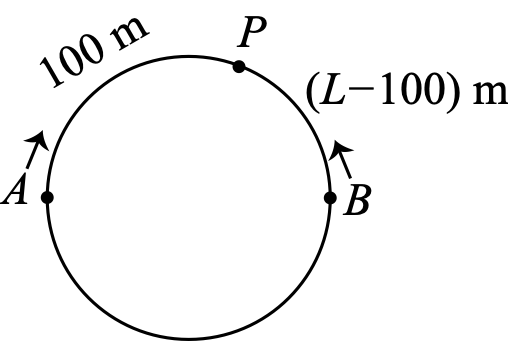
Consider the interval of time from the start to when they first meet. In
the diagram, AA is Arun’s starting
point, BB is Bella’s starting point,
and PP is this first meeting
point.

Figure 0

Since Arun has run 100 m100\text{ m}
and together they have covered half of the length of the track, then
Bella has run (L100) m(L - 100)\text{ m}.

Thus, ab=100L100\dfrac{a}{b} = \dfrac{100}{L-100}.

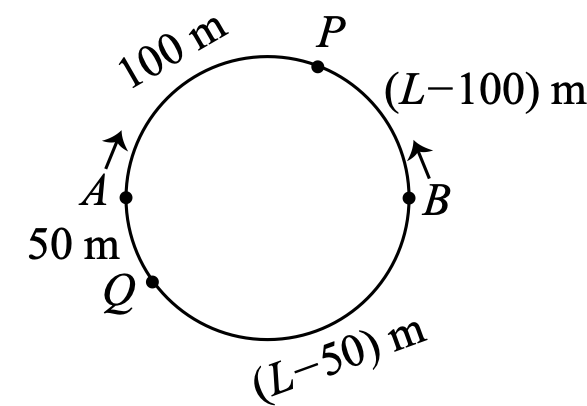
From their first meeting point PP to
their second meeting point, which we label QQ, Bella runs 150 m150\text{ m}.

Figure 1

Over this time, Arun runs from PP
to BB to QQ.

Since Bella runs 150100=50 m150 - 100 = 50\text{ m} past AA, then QB=(L50) mQB = (L - 50)\text{ m} (because AB=L mAB = L\text{ m} and AQ=50 mAQ = 50\text{ m}) and so Arun runs (L100) m+(L50) m(L - 100)\text{ m} + (L - 50)\text{ m}
which is equal to (2L150) m(2L - 150)\text{ m}.

Thus, over this second interval of time, ab=2L150150\dfrac{a}{b} = \dfrac{2L-150}{150}.

Equating expressions for ab\dfrac{a}{b} and solving, 100L100amp;=2L150150100150amp;=(L100)(2L150)15000amp;=2L2350L+15000350Lamp;=2L2\begin{align*} \dfrac{100}{L-100} & = \dfrac{2L-150}{150} \\ 100 \cdot 150 & = (L-100)(2L-150) \\ 15\,000 & = 2L^2 - 350L + 15\,000 \\ 350L & = 2L^2\end{align*} Since L0L \neq 0, then 2L=3502L = 350, and so the total length of the
track is 350 m350\text{ m}.

Checking, if the length of the track is 350 m350\text{ m}, then half of the length is
75 m75\text{ m}.

This means that from the start to PP, Arun runs 100 m100\text{ m} and Bella runs 75 m75\text{ m}.

Also, from PP to QQ, Bella runs 150 m150\text{ m} and Arun runs 200 m200\text{ m}.

Note that 10075=200150\dfrac{100}{75} = \dfrac{200}{150} so these numbers are consistent with the given
information.
Using exponent laws, the following equations are equivalent:
41+cos3θamp;=22cosθ8cos2θ(22)1+cos3θamp;=22cosθ(23)cos2θ22+2cos3θamp;=22cosθ23cos2θ22+2cos3θamp;=22cosθ+3cos2θ2+2cos3θamp;=2cosθ+3cos2θ2cos3θ3cos2θ+cosθamp;=0cosθ(2cos2θ3cosθ+1)amp;=0cosθ(2cosθ1)(cosθ1)amp;=0\begin{align*} 4^{1 + \cos^3 \theta} & = 2^{2 - \cos\theta} \cdot 8^{\cos^2\theta} \\ (2^2)^{1 + \cos^3 \theta} & = 2^{2 - \cos\theta} \cdot (2^3)^{\cos^2\theta} \\ 2^{2 + 2\cos^3 \theta} & = 2^{2 - \cos\theta} \cdot 2^{3\cos^2\theta} \\ 2^{2 + 2\cos^3 \theta} & = 2^{2 - \cos\theta + 3\cos^2\theta} \\ 2 + 2\cos^3 \theta & = 2 - \cos\theta + 3\cos^2\theta \\ 2\cos^3\theta - 3\cos^2\theta + \cos\theta & = 0 \\ \cos\theta(2\cos^2 \theta - 3 \cos\theta + 1) & = 0\\ \cos\theta(2\cos \theta - 1)(\cos\theta - 1) & = 0\end{align*} and so cosθ=0\cos \theta = 0 or cosθ=1\cos \theta = 1 or
cosθ=12\cos \theta = \frac{1}{2}.

Since 0°θ360°0\degree \leq \theta \leq 360\degree, the solutions are θ=90°,270°,0°,360°,60°,300°\theta = 90\degree, 270\degree, 0\degree, 360\degree, 60\degree, 300\degree.

Listing these in increasing order, the solutions to the original
equation are θ=0°,60°,90°,270°,300°,360°\theta = 0\degree, 60\degree, 90\degree, 270\degree, 300\degree, 360\degree

Want a route through all this instead of an archive? The track puts 2,604 problems in a working order, from Junior Challenge level to the IMO shortlist.

Source: CEMC, University of Waterloo, licensed CC-BY-NC-4.0. Statement reproduced verbatim; metadata (topic, difficulty) added by this project.