In the diagram, line segment has length 4. Points and are on line segment . Four semi-circles are drawn on the same side of . The diameters of these semi-circles are , , , and . The region inside the largest semi-circle and outside the three smaller semi-circles is shaded.
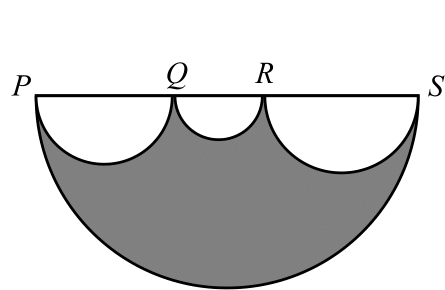
What is the area of a square whose perimeter equals the perimeter of the shaded region?
CEMC Pascal, 2014
Pick one
Solution
The perimeter of the shaded region consists of four pieces: a semi-circle with diameter , a semi-circle with diameter , a semi-circle with diameter , and a semi-circle with diameter .
We note that since a circle with diameter has circumference equal to , then, not including the diameter itself, the length of a semi-circle with diameter is .
Suppose that the diameter of semi-circle is , the diameter of semi-circle is , and the diameter of semi-circle is .
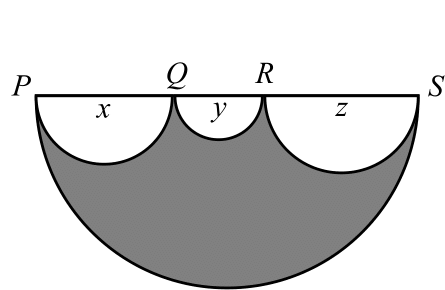
We are given that the diameter of the semi-circle is 4.
Since , then .
Thus, the perimeter of the shaded region is We want to determine the area of the square whose perimeter equals this perimeter (that is, whose perimeter is ).
If a square has perimeter , then its side length is , and so its area is .
Because this problem is multiple choice, then we should get the same answer regardless of the actual lengths of , and , since we are not told what these lengths are. Therefore, we can assign to these lengths arbitrary values that satisfy the condition . For example, if and , then we can calculate the perimeter of the shaded region to be and obtain the same answer as above.
Want a route through all this instead of an archive? The track
puts 2,604 problems in a working order, from Junior Challenge level to the IMO shortlist.