A square is cut along a diagonal and reassembled to form the parallelogram as shown in the diagram.
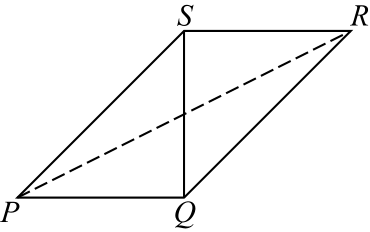
If , what is the area of the original square, in ?
CEMC Fermat, 2014
Pick one
Solution
Suppose that the original square had side length mm.
We extend and draw a line through perpendicular to , meeting extended at .
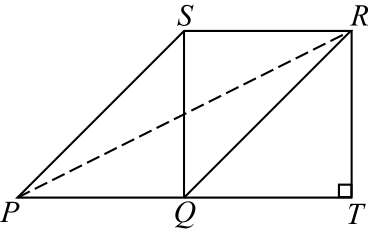
is a square, since it has three right angles at , , (which makes it a rectangle) and since (which makes the rectangle a square).
Now mm and mm.
By the Pythagorean Theorem, and so .
Therefore, or .
The area of the original square is , which equals .
Want a route through all this instead of an archive? The track
puts 2,604 problems in a working order, from Junior Challenge level to the IMO shortlist.