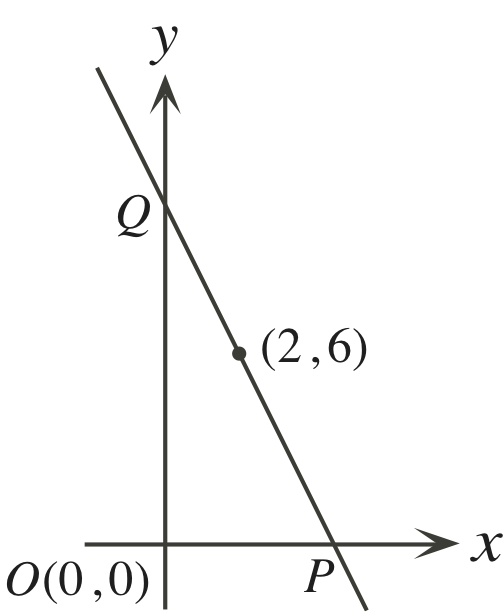
The slope of the line is m=−3; thus its equation is y=−3x+b with y-intercept b. Since the line passes through the point (2,6), then x=2 and y=6 satisfy the equation of the line. Substituting x=2 and y=6 into the equation of the line, then 6=−3(2)+b and so b=12. The equation of the line is y=−3x+12 and the line has y-intercept 12. To find the x-intercept, we let y=0 and solve for x. Thus, 0=−3x+12 or 3x=12, and so the line has x-intercept 4. The slope of the line is m; thus its equation is y=mx+b with y-intercept b. Since the line passes through the point (2,6), then x=2 and y=6 satisfy the equation of the line. Substituting x=2 and y=6 into the equation of the line, then 6=2m+b and so b=6−2m. The equation of the line is y=mx+(6−2m) and the line has y-intercept 6−2m. To find the x-intercept, we let y=0 and solve for x. Thus, 0=mx+(6−2m) or mx=2m−6 or x=m2m−6, and so the line has x-intercept 2−m6. (We require m=0, otherwise the line is horizontal and the x-intercept does not exist.) The line through the point (2,6) with slope m has x-intercept 2−m6 and y-intercept 6−2m, as determined in part (b). (We require m=0, otherwise the line is horizontal and the x-intercept, P, does not exist.) Since P is the x-intercept of this line, OP has length 2−m6. Since Q is the y-intercept of this line, OQ has length 6−2m. Therefore, the area of △POQ is given by 21(OP)(OQ)=21(2−m6)(6−2m). Since the area of △POQ is 25, then 21(2−m6)(6−2m)=25. Solving for m, 21(2−m6)(6−2m)(2−m6)(6−2m)(2m−6)(6−2m)12m−4m2−36+12m4m2+26m+362m2+13m+18(2m+9)(m+2)=25=50=50m=50m=0=0=0 Therefore, two possible values are m=−29 and m=−2. Since P and Q lie on the positive x-axis and the positive y-axis respectively, we must check that these two values for m give 2−m6>0 and 6−2m>0. When m=−29, 2−m6=2+296 which is greater than 0. When m=−29, 6−2m=6+2(29) which is also greater than 0. When m=−2, 2−m6=2+26 which is greater than 0. When m=−2, 6−2m=6+2(2) which is also greater than 0. Therefore, the two values of m for which P and Q lie on the positive x-axis and the positive y-axis, respectively, and for which △POQ has area 25, are m=−29 and m=−2. Note: If we remove the restriction that P and Q both be located on their respective positive axes, then there are two more values of m for which △POQ has area 25. Can you determine these?