Consider the following diagram.
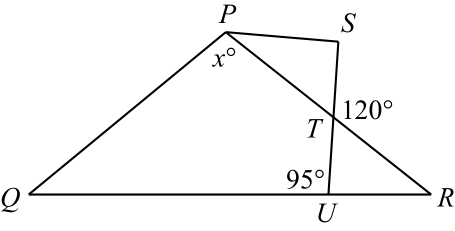
Since S,T,U lie on a straight line, ∠STU measures 180∘.
Therefore, ∠RTU=180∘−∠STR=180∘−120∘=60∘.
Similarly, Q,U,R lie on a straight line, and so ∠QUR
measures 180∘.
Therefore, ∠TUR=180∘−∠TUQ=180∘−95∘=85∘.
The sum of the angles in △TUR is 180∘.
Thus, ∠TRU=180∘−∠RTU−∠TUR=180∘−60∘−85∘=35∘.
Since △PQR is isosceles with PQ=PR, then ∠PQR=∠PRQ=35∘.
Finally, the sum of the angles in △PQR is 180∘, and so x∘=180∘−∠PQR−∠PRQ or x∘=180∘−35∘−35∘ and so x=110.
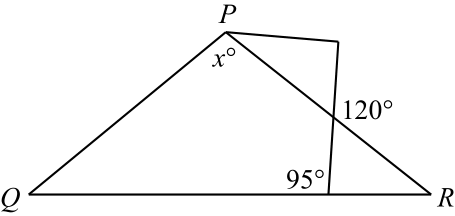 What is the value of ?