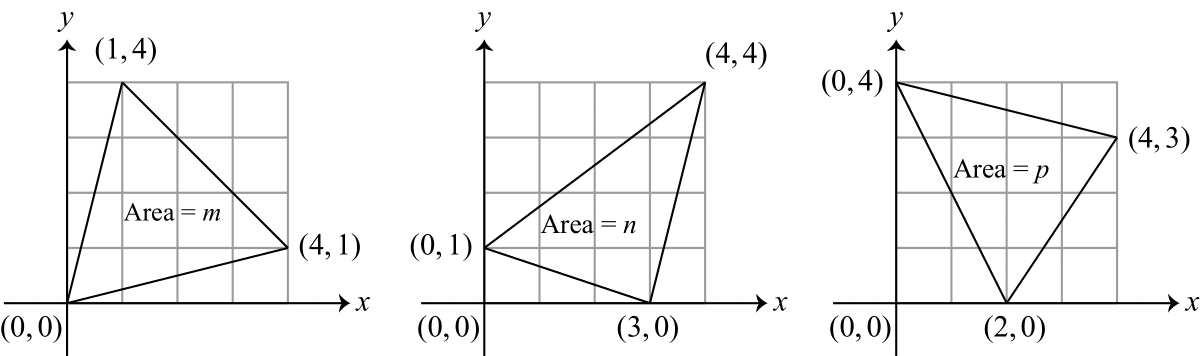
In each diagram, we label the origin (0,0) as O, the point (4,0) as A, the point (4,4) as B, and the point (0,4) as C.
Thus, in each diagram, square OABC is 4 by 4 and so has area 16.
In the first diagram, we label (1,4) as E and (4,1) as F.
In the second diagram, we label (0,1) as G and (3,0) as H.
In the third diagram, we label (2,0) as J and (4,3) as K.
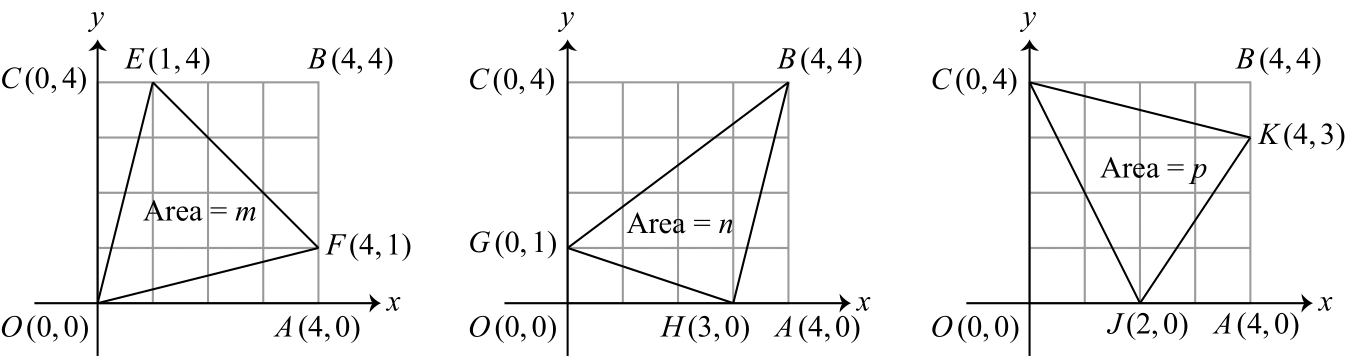
In the first diagram, the area of △OEF equals the area of square OABC minus the areas of △OCE, △EBF and △FAO.
Each of these three triangles is right-angled at a corner of the square.
Since OC=4 and CE=1, the area of △OCE is 21(4)(1)=2.
Since EB=3 and BF=3, the area of △EBF is 21(3)(3)=29.
Since FA=1 and AO=4, the area of △FAO is 21(1)(4)=2.
Therefore, the area of △OEF equals 16−2−29−2=215, or m=215.
In the second diagram, the area of △GBH equals the area of square OABC minus the areas of △GCB, △BAH and △HOG.
Each of these three triangles is right-angled at a corner of the square.
Since GC=3 and CB=4, the area of △GCB is 21(3)(4)=6.
Since BA=4 and AH=1, the area of △BAH is 21(4)(1)=2.
Since HO=3 and OG=1, the area of △HOG is 21(1)(3)=23.
Therefore, the area of △HOG equals 16−6−2−23=213, or n=213.
In the third diagram, the area of △CKJ equals the area of square OABC minus the areas of △CBK, △KAJ and △JOC.
Each of these three triangles is right-angled at a corner of the square.
Since CB=4 and BK=1, the area of △CBK is 21(4)(1)=2.
Since KA=3 and AJ=2, the area of △KAJ is 21(3)(2)=3.
Since JO=2 and OC=4, the area of △JOC is 21(2)(4)=4.
Therefore, the area of △CKJ equals 16−2−3−4=7, or p=7.
Since m=215=721, and n=213=621, and p=7, then n lt;p lt;m.