In the diagram, each of ,
and is greater than zero.
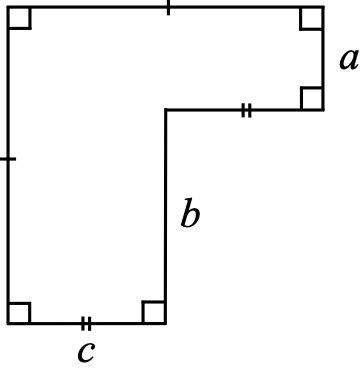
Which of the following expressions is not equal to the
perimeter of this polygon?
In the diagram, each of ,
and is greater than zero.
Which of the following expressions is not equal to the
perimeter of this polygon?
Pick one
In the first diagram shown, we label the vertices of the polygon
and the length , since .
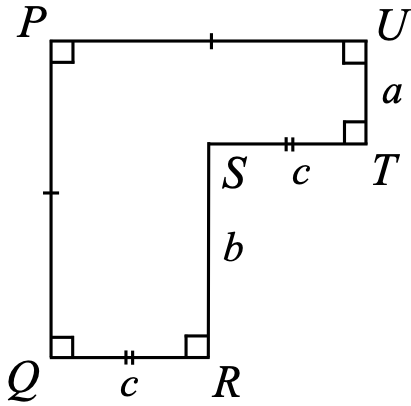
Next, we extend by a length
equal to , and we extend by a length equal to , as shown in the second diagram.
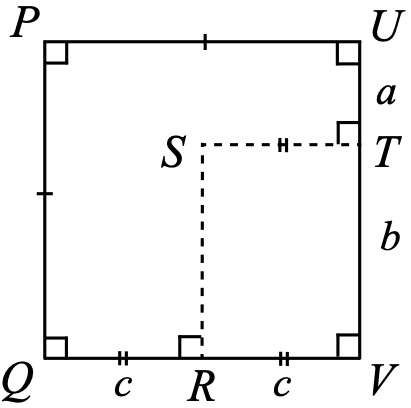
Each of the angles in the polygon is a right angle, and so these two
extended line segments are perpendicular to each other and will meet at
a point that we label .
That is, is a rectangle with
and .
Each of the following expressions is equal to the perimeter of the
original polygon which is the perimeter of .
Each of the angles in is a
right angle, and , and thus
is a square.
Since , and , then .
Summarizing, the perimeter of the original polygon is equal to the
perimeter of square , and each
side length of square can be
expressed as or as since .
If each of the side lengths is
expressed as , then the
perimeter of (and thus the
perimeter of the original polygon), is equal to .
If side lengths are expressed as
and side length is expressed as , then the perimeter is .
If side lengths are expressed as
and side lengths are expressed as , then the perimeter is .
If side length is expressed as
and side lengths are expressed as , then the perimeter is .
Finally, if all sides lengths are
expressed as , the perimeter is
.
Of the expressions given,
remains, and since
is not equal to the perimeter, then the correct answer is (B).