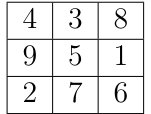
A magic square is a grid of numbers in which the sum of the numbers in each row, in each column, and on each of the two main diagonals is equal to the same number (called the magic constant). For example, the grid with rows ; ; is a magic square because the sum of the numbers in each row, in each column, and on each of the two main diagonals is equal to . ( is the magic constant.)
(a) A magic square is to be formed using the nine integers from to .
(i) Calculate the sum of the nine integers from to .
(ii) Determine the magic constant for this magic square and explain how you found it.
(iii) Complete the magic square starting with the entries: top row ; middle row ; bottom row .
(b) A magic square is to be formed using the sixteen integers from to .
(i) Calculate the sum of the sixteen integers from to .
(ii) Determine the magic constant for this magic square and explain how you found it.
(iii) Complete the magic square starting with the entries: row 1: ; row 2: ; row 3: ; row 4: .