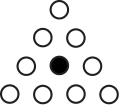
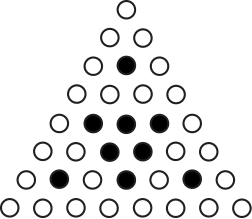
Since each Figure is formed by placing two copies of the previous Figure side-by-side along the base and then adding other pieces above, the number of dots in the base of each Figure is two times as many as in the previous Figure.
Since each Figure is an equilateral triangle, then the number of dots in the Figure equals the sum of the positive integers from 1 to the number of dots in the base, inclusive. In other words, if the base of a Figure consists of b dots, then the Figure includes 1+2+3+⋯+(b−1)+b dots. This sum is equal to 21b(b+1). (If this formula for the sum is unfamiliar, can you argue why it is true?)
Since each Figure is formed by using three copies of the previous Figure and any new dots added are shaded dots, the number of unshaded dots in each Figure is exactly three times the number of unshaded dots in the previous Figure.
Since each dot is either shaded or unshaded, the number of shaded dots equals the total number of dots minus the number of unshaded dots.
Using these statements, we construct a table:
Therefore, the smallest value of n for which Figure n includes at least 100 000 dots is n=9.
We note that since the number of dots in the base of Figure 1 is 2 and the number of dots in the base of each subsequent Figure is double the number of dots in the previous Figure, then the number of dots in the base of Figure n is equal to 2n.
Since the number of unshaded dots in Figure 1 is 3 and the number of unshaded dots in each subsequent Figure is three times the number of unshaded dots in the previous Figure, then the number of unshaded dots in Figure n is 3n.
Therefore, a formula for the number of unshaded dots in Figure n is 212n(2n+1)−3n which can be re-written as 22n−1+2n−1−3n, which agrees with the numbers in the table above.