A bag contains marbles of five different colours. One marble is chosen at random. The probability of choosing a brown marble is 0.3. Choosing a brown marble is three times as likely as choosing a purple marble. Choosing a green marble is equally likely as choosing a purple marble. Choosing a red marble is equally likely as choosing a yellow marble. The probability of choosing a marble that is either red or green is
CEMC Gauss (Grade 8), 2018
Pick one
Solution
The figure formed by combining a pair of adjacent small parallelograms, is also a parallelogram.
For example, each of the two figures shown is a parallelogram.
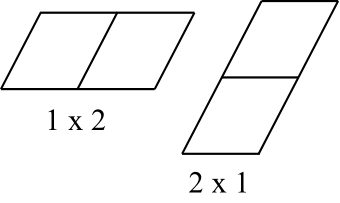
The reason for this is that opposite sides of these new figures are equal in length and they are parallel. We use the notation to mean that the new figure has rows of the small parallelograms and columns of the small parallelograms.
Similarly, more than 2 small parallelograms can be combined to form new parallelograms.
In addition to the small parallelogram () and the and parallelograms shown above, the sizes of the remaining parallelograms that appear in the figure are shown below.

In the table below, the number of parallelograms of each of the different sizes is shown.
| Size | ||||||||
|---|---|---|---|---|---|---|---|---|
| Number of Parallelograms | 8 | 6 | 4 | 4 | 2 | 3 | 2 | 1 |
The number of parallelograms appearing in the figure is .
Want a route through all this instead of an archive? The track
puts 2,604 problems in a working order, from Junior Challenge level to the IMO shortlist.