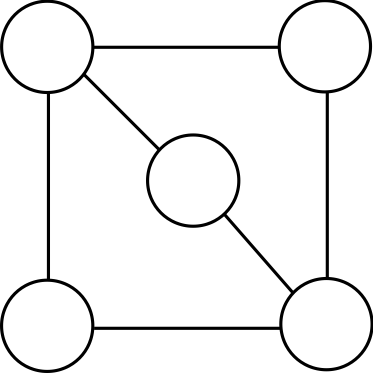
Suppose the integer in the centre circle is a.
Then each integer in a circle connected to the centre circle is either
d more than a, which is a+d, or it is d less than a, which is a−d.
The integers in the two circles connected to the centre could both be
a+d, as in Figure 1 below, or they
could both be a−d, as in Figure 2,
or one could be a−d and one could
be a+d, as in Figure 3.
We note that in the last case (Figure 3), swapping locations of the
a−d and the a+d does not change the integers in the
final two empty circles (since they still depend on a+d and a−d), and thus does not change the sum of
the five integers.
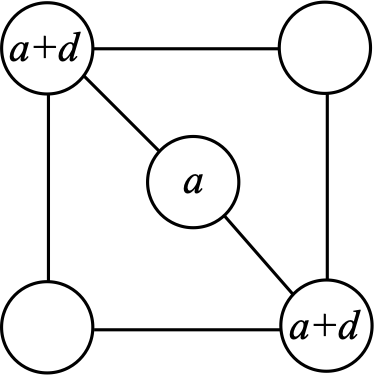
Figure 1
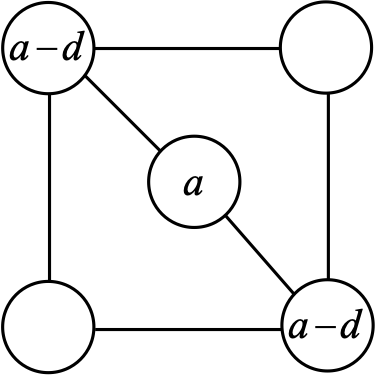
Figure 2
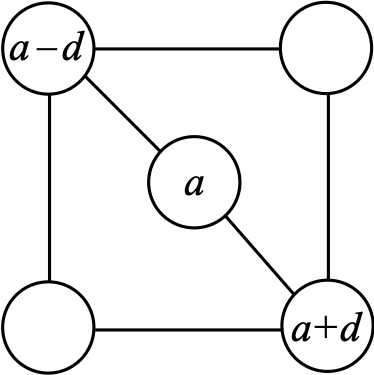
Figure 3
Next, we explain why it is possible to place integers into the
remaining two circles (in each of the three cases above) so that the
positive difference between each pair of integers in connected circles
is d.
For the case that began in Figure 1, the integers in the two empty
circles are either d more than
a+d, which is a+2d, or they are d less than a+d, which is a.
These integers could both be a+2d,
as in Figure 1a below, or they could both be a, as in Figure 1b, or one could be a+2d and one could be a, as in Figure 1c.
We note that in the last case (Figure 1c), swapping locations of the
final two integers, a+2d and a, does not change the sum of the five
integers.
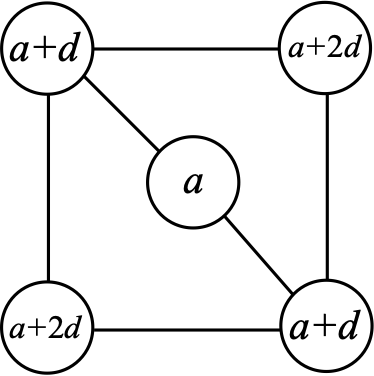
Figure 1a
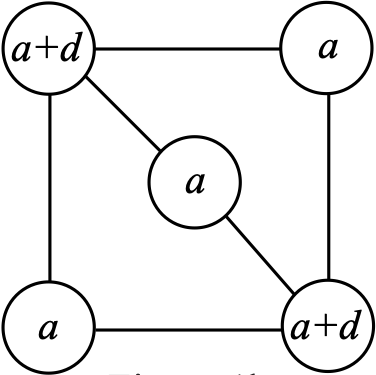
Figure 1b
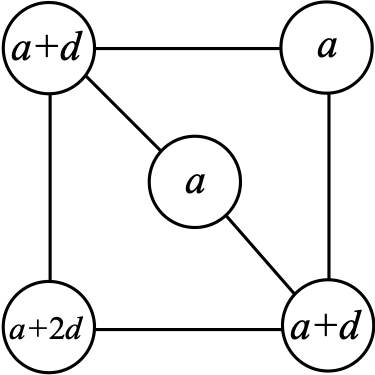
Figure 1c
For the case that began in Figure 2, the integers in the two empty
circles are either d more than
a−d, which is a, or they are d less than a−d, which is a−2d.
These integers could both be a, as
in Figure 2a below, or they could both be a−2d, as in Figure 2b, or one could be
a and one could be a−2d, as in Figure 2c.
We again note that in the last case (Figure 2c), swapping locations of
the final two integers, a and a−2d, does not change the sum of the five
integers.
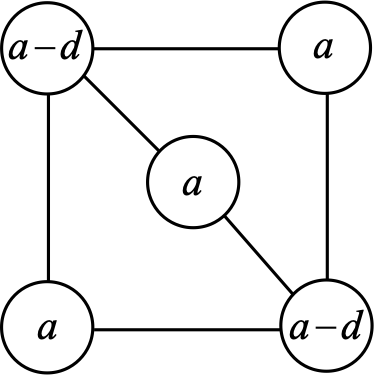
Figure 2a
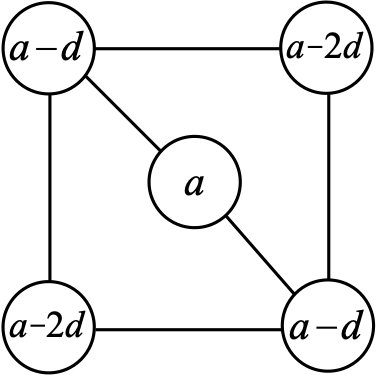
Figure 2b
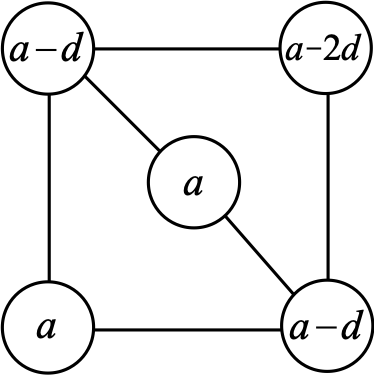
Figure 2c
Finally, for the case that began in Figure 3, each integer in an
empty circle must have a positive difference of d with both a−d and a+d.
The integer d more than a−d is a, and the integer d less than a−d is a−2d.
The integer d more than a+d is a+2d, and the integer d less than a+d is a.
Thus, a is the only integer that
has a positive difference of d with
both a−d and a+d, and so the integers in the two empty
circles must each be equal to a, as
shown in Figure 3a.
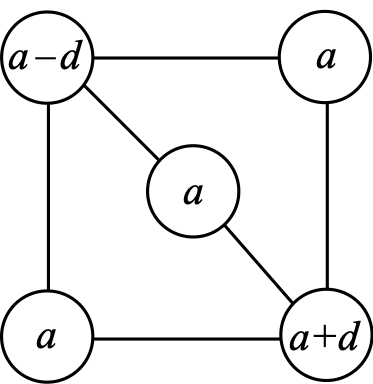
Figure 3a
Suppose that the sum of the five integers in the circles is S.
For Case 1a (which corresponds to Figure 1a), adding the five integers
in the figure, we getS=a+(a+d)+(a+2d)+(a+d)+(a+2d)=5a+6d.
In the table below, we determine the value of S for each of the 7 cases.
We must determine the number of different integers d, between 1 and 20 inclusive, for which at least one of
the seven expressions for S is
equal to 54 and a is an integer.
Consider Case 1a, from which we get 5a+6d=54.
Since both a and d are integers, and d is between 1 and 20 inclusive, we can systematically
substitute values of d into this
equation, and then solve for a to
determine if a is an integer.
For example if d=1, we get 5a+6×1=54 or 5a=48.
However, there is no integer a for
which 5a=48 and so d=1 is not a possible value of d in Case 1a. Substituting d=2 and d=3 similarly give non-integer values of
a.
When d=4, we get 5a+6×4=54 and so 5a=30 or a=6.
In this case, the pair of integers d=4 and a=6 satisfy the equation 5a+6d=54.
Substituting d=4 and a=6 into Figure 1a, we get the following
diagram.
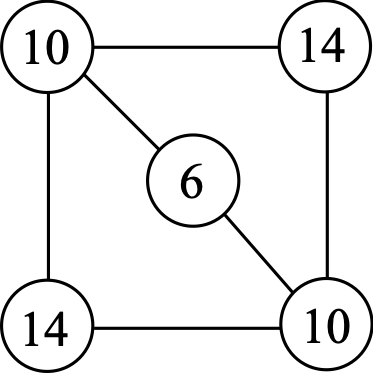
We can confirm that the positive difference between each pair of
integers in connected circles is 4
(an integer between 1 and 20 inclusive), and the sum of the five
integers in the circles is 54, as
required. Thus d=4 is a possible
value satisfying the given conditions.
We can systematically continue to substitute d=5,6,7,…,20 into 5a+6d=54 and solve the equation to
determine which values of d give
integer values of a.
The next smallest value of d for
which a is an integer is d=9. In this case, we get 5a+6×9=54 and so 5a=0 or a=0.
We could continue in this systematic way, however since there are 20 possible values of d and 7 cases to check, this would take a while
to complete. Instead, we might recognize that d=4, a=6 and d=9, a=0 are both solutions to 5a+6d=54.
Notice that from the first solution to the second, the value of d increases by 5, and the value of a decreases by 6.
Can you see why increasing d by
5 and decreasing a by 6 gives the next possible pair of
integers for which 5a+6d=54? (Hint:
Take a close look at the left side of the equation.)
If we increase d by 5 again, and decrease a by 6, we get d=9+5=14 and a=0−6=−6, and since 5a+6d=5×(−6)+6×14=−30+84=54,
then d=14 and a=−6 is a solution to the equation (and
in fact, this is the next smallest value of d that works).
The final integer value of d
between 1 and 20 inclusive for which 5a+6d=54 is d=14+5=19, and in this case a=−6−6=−12 or (d,a)=(19,−12)
Therefore, Case 1a gives d=4,9,14,
and 19, or 4 values of d which satisfy the given conditions.
We continue in this way for each of the first four cases, and
summarize all possible integer solutions for those cases in the table
below.
Notice that after the first four cases shown above, all possible
values of d from 1 to 20 inclusive satisfy the given conditions
with the exception of d=5,10,15,
and 20.
In Case 3a we get, 5a=54 and so
a is not an integer. Next, consider
Case 2b, 5a−6d=54.
Each value of d left to check
(d=5,10,15,20) is a multiple of
5, and so 6d is a multiple of 5 for each of these possible values of
d.
Since 5a is also a multiple of
5 for all possible integers a, then 5a−6d is the difference between two
multiples of 5, and thus is a
multiple of 5.
However, the right side of the equation 5a−6d=54 is not a multiple of 5 and so d cannot be equal to a multiple of 5.
In the final case, 5a−4d=54, it is
similarly not possible for d to be
equal to a multiple of 5.
Thus d can be equal to each of the
first 20 positive integers with the
exception of 5,10,15, and 20, and so there are 20−4=16 different possible values of
d.
It is worth noting that there are many different ways to find the
integer solutions to each of the 7
equations (cases) above. For example, the value of each of the terms
6d, 2d, 4d, −2d, −6d, −4d, 0d is even for all integers d, and the right side of each equation,
54, is also even. This means that
in each equation, the value of 5a
must be even, and so a is even.
Further, when a is even, the units
digit of 5a is 0. Since the units digit of 54 is 4, what do we now know about the units
digit of each term containing a d,
and in each case, what does that tell us about the possible values of
d?