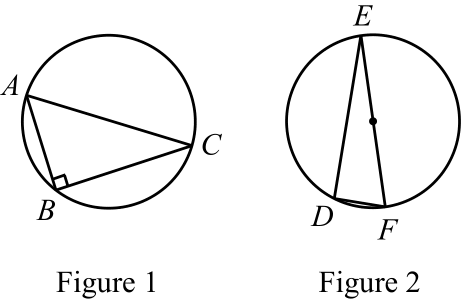
If points A, B, C lie on a circle so that ∠ABC=90∘, then AC is a diameter of the circle. This means that in Figure 1, AC is a diameter of the circle. If points D, E, F lie on a circle so that EF is a diameter, then ∠EDF=90∘. This means that in Figure 2, ∠EDF=90∘.
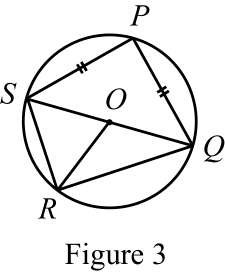
In Figure 1 above, AB=8 and BC=15. What is the length of diameter AC? In Figure 2 above, DE=24 and the radius of the circle is 13. What is the length of DF? In Figure 3, points P, Q, R, and S are on a circle with centre O. Also, SQ is a diameter of the circle and O is joined to R. If SP=PQ and ∠RQP=80∘, determine the measure of ∠ROQ and the measure of ∠RSQ.
Solution
In △ABC, ∠ABC=90∘.
Using the Pythagorean Theorem, we get AC2=AB2+BC2 or AC2=82+152, and so AC=64+225=289=17 (since AC gt;0). In Figure 2, EF is a diameter and so its length is twice the radius or 26.
From the second fact, we know that ∠EDF=90∘.
Using the Pythagorean Theorem, we get DF2=EF2−DE2 or DF2=262−242, and so DF=676−576=100=10 (since DF gt;0). Since SQ is a diameter, then ∠SPQ=∠SRQ=90∘.
In △SPQ, SP=PQ which means that △SPQ is isosceles and so
∠PQS=∠PSQ=2180∘−90∘=45∘.
Since ∠RQP=80∘, then ∠RQO=∠RQP−∠PQS=80∘−45∘=35∘.
In △ROQ, OR=OQ (both are radii) and so ∠QRO=∠RQO=35∘ and
∠ROQ=180∘−2×35∘=110∘.
In △SRQ, we get ∠RSQ=180∘−∠SRQ−∠RQS=180∘−90∘−35∘=55∘.
Want a route through all this instead of an archive? The track
puts 2,604 problems in a working order, from Junior Challenge level to the IMO shortlist.