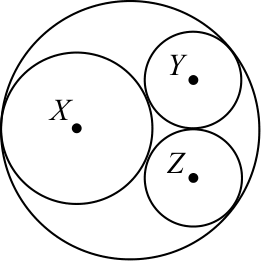
In the diagram, the circle with centre X is tangent to the largest circle and passes through the centre of the largest circle. The circles with centres Y and Z are each tangent to the other three circles, as shown.
The circle with centre X has radius 1. The circles with centres Y and Z each have radius r. The value of r is closest to
0.93 0.91 0.95 0.87 0.89
A number or a short expression. Fractions can be typed as 3/2, and spacing doesn't matter.
Solution
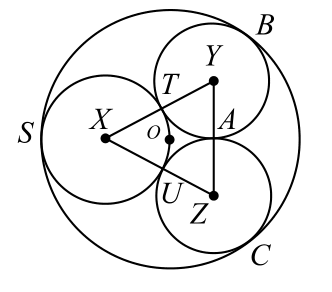
Suppose the centre of the largest circle is O. Suppose that the circle with centre X touches the largest circle at S and the two circles with centres Y and Z at T and U, respectively. Suppose that the circles with centres Y and Z touch each other at A, and the largest circle at B and C, respectively. Join X to Y, X to Z, and Y to Z.
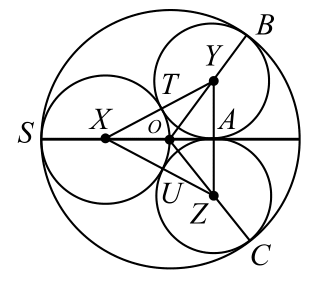
(Note that the diagram has been re-drawn here so that the circle with centre X actually appears to pass through the centre of the largest circle.) Since the circles are tangent at points T and U, line segments XY and XZ pass through T and U, respectively. Further, XY=XT+TY=1+r, since the circles with centres X and Y have radii 1 and r, respectively. Similarly, XZ=1+r. Also, YA=ZA=YB=ZC=r, since these are radii of the two circles. When one circle is inside another circle, and the two circles touch at a point, then the radii of the two circles that pass through this point lie on top of each other. This is because the circles have a common tangent at the point where they touch and this common tangent will be perpendicular to each of the radii. Since the circle with centre X touches the largest circle at S, then X lies on OS. In the largest circle, consider the diameter that passes through X. Since the circle with centre X passes through O, then the radius of the largest circle is twice that of the circle with centre X, or 2. It is also the case that XO=1. Next, we join O to B. Since the circles with centres O and Y touch at B, then OB passes through Y. This means that OY=OB−BY=2−r. Similarly, OZ=2−r. Further, by symmetry in the largest circle, the diameter through X also passes through A, the point at which the two smallest circles touch:
To see this more formally, draw the common tangent through A to the circles with centres Y and Z. This line is perpendicular to YZ, since it is tangent to both circles. Since △OYZ is isosceles with OY=OZ, the altitude through the midpoint A of its base passes through O. Similarly, △XYZ is isosceles with XY=XZ and so its altitude through A passes through X. Since the line perpendicular to YZ at A passes through both O and X, it is the diameter that passes through X.
Now, we consider △XYA and △OYA, each of which is right-angled at A. By the Pythagorean Theorem, OA=OY2−YA2=(2−r)2−r2=4−4r+r2−r2=4−4r Again, using the Pythagorean Theorem, XA 2 + YA 2 amp; = XY 2 (XO + OA) 2 + r 2 amp; = (1+r) 2 (1 + 4-4r ) 2 amp; = 1+2r + r 2 - r 2 1 + 2 4-4r + (4-4r) amp; = 1+2r 2 4 - 4r amp; = 6r - 4 4-4r amp; = 3r - 2 4 - 4r amp; = (3r-2) 2 (squaring both sides) 4 - 4r amp; = 9r 2 - 12r + 4 8r amp; = 9r 2 Since r=0, then 9r=8 and so r=98≈0.889. Of the given choices, this is closest to (E) 0.89.
Want a route through all this instead of an archive? The track
puts 2,604 problems in a working order, from Junior Challenge level to the IMO shortlist.