The figure consists of five squares and two right-angled triangles.
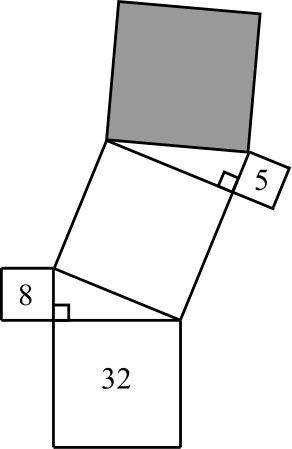
The areas of three of the squares are 5, 8 and 32, as shown. What is the area of the shaded square?
The figure consists of five squares and two right-angled triangles.
The areas of three of the squares are 5, 8 and 32, as shown. What is the area of the shaded square?
The Pythagorean Theorem tells us that if a right-angled triangle has sides of length , and , with the hypotenuse, then .
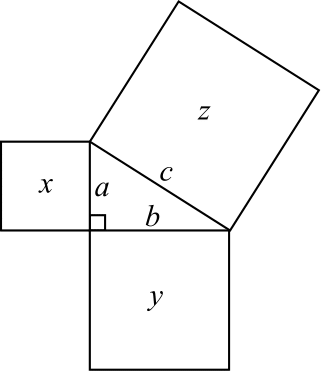
Since the area of a square of side length is , the Pythagorean Theorem can be re-phrased to say that the sum of the areas of the squares that can be drawn on the two shorter sides equals the area of the square that can be drawn on the hypotenuse. (In the figure below, this says that where , and are the areas of the squares, as shown.)
In the given diagram, this means that the area of the unmarked, unshaded square is .
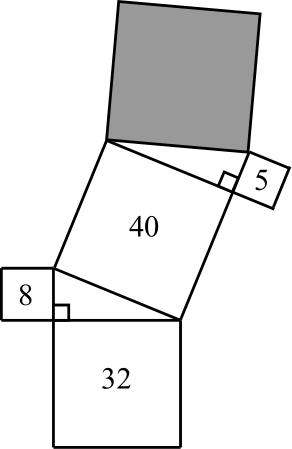
This means that the area of the shaded square is .