The three different integers selected from 1 to 6 and whose sum is 7 must be the integers 1, 2, 4. Thus, the vertical column contains the
integers 1, 2, 4
in some order.
(Can you see why no other combination of three of the given integers has
a sum of 7?)
The three different integers selected from 1 to 6 and whose sum is 11 must be 1, 4, 6
or 2, 4, 5
or 2, 3, 6.
If the integers in the horizontal row are 1, 4, 6, then there are two integers in common
with those in the vertical column, namely 1 and 4.
Since there have to be five different integers used in the squares, then
there cannot be two integers in common between the two lists, and so
1, 4, 6
cannot appear in the horizontal row.
Similarly, 2, 4, 5
cannot appear in the horizontal row.
Thus, the horizontal row must contain the integers 2, 3, 6
with 2 appearing in the centre
square since it is the integer in common between the two lists.
The integer not appearing in any square is 5.
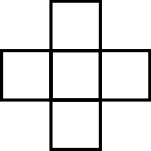
The figure shows a possible arrangement of the integers.