Hexagon has
vertices , , , , , . What is the area of hexagon ?
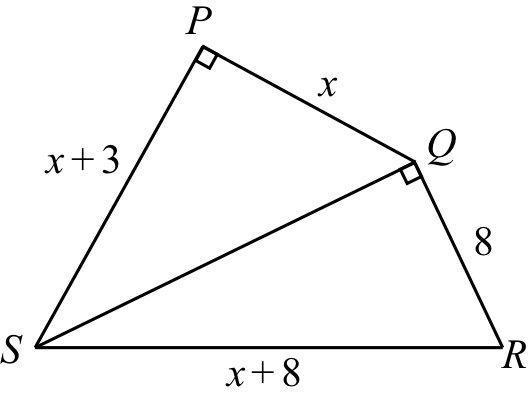
In the diagram, is right-angled at
and is right-angled
at . Also, , , , and for some real number . Determine all possible values of the
perimeter of quadrilateral .
Hexagon has
vertices , , , , , . What is the area of hexagon ?
In the diagram, is right-angled at
and is right-angled
at . Also, , , , and for some real number . Determine all possible values of the
perimeter of quadrilateral .
Let be the point with
coordinates and let be the point with coordinates .
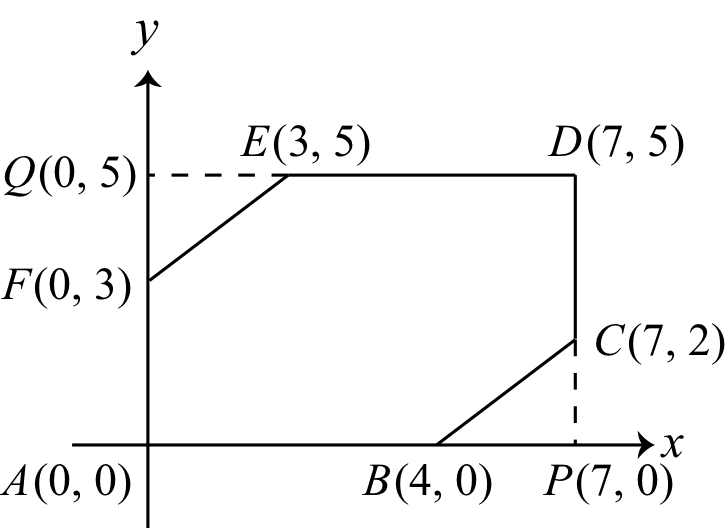
Then is a rectangle with
width 7 and height 5, and so it has area .
Hexagon is formed by
removing two triangles from rectangle , namely and .
Each of and is right-angled, because
each shares an angle with rectangle .
Each of and has a base of length 3 and
a height of 2.
Thus, their combined area is .
This means that the area of hexagon is .
Since is
right-angled at , then by the
Pythagorean Theorem, Since is right-angled at ,
then by the Pythagorean Theorem, we obtain and so or .
(We can check that if , has sides of lengths 4, 1
and and has sides of lengths , 8 and 9, both of which are
right-angled, and if , has sides of lengths 12, 9
and 15 and has sides
of lengths 15, 8 and 17, both of which are right-angled.)
In terms of , the perimeter of
is .
Thus, the possible perimeters of are 22 (when ) and 46 (when ).