The graph of the equation y=r(x−3)(x−r) intersects the y-axis at (0,48). What are the two possible values of r? A bicycle costs $B before taxes. If the sales tax were 13%, Annemiek would pay a total that is $24 higher than if the sales tax were 5%. What is the value of B? The function f has the following three properties:
f(1)=3. f(2n)=(f(n))2 for all positive integers n. f(2m+1)=3f(2m) for all positive integers m.
Determine the value of f(2)+f(3)+f(4).
Solution
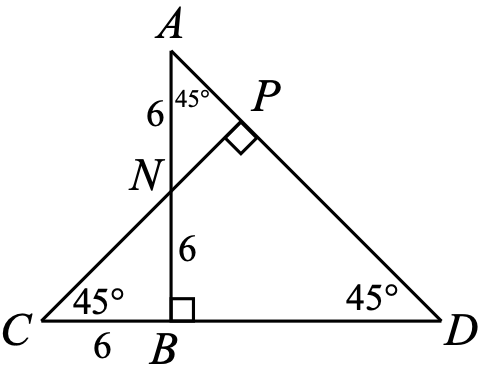
Since △ABD is right-angled at B and has ∠ADB=45°, then ∠BAD=45°.
Similarly, △CPD is right-angled and isosceles with ∠PCD=45°.
Further, △APN and △CBN are also both right-angled and isosceles.
Since CB=6 and NB=CB, then NB=6.
Since AB=12 and NB=6, then AN=AB−NB=6.
Since △APN is right-angled and isosceles, then its sides are in the ratio 1:1:2.
Thus, AP=PN=21AN=26=32.
Alternatively, if AP=PN=x, then the Pythagorean Theorem gives AN2=AP2+PN2 and so 62=2x2 which gives AP2=x2=18.
Thus, the area of △APN is 21⋅AP⋅PN=21⋅32⋅32=9. The line with equation y=−3x+6 has y-intercept 6, which means that OB=6.
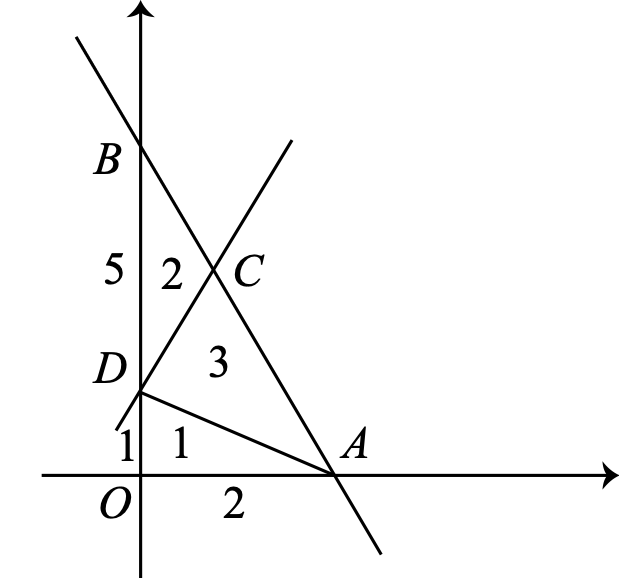
To find the x-intercept of this line, we set y=0 and obtain the equation −3x+6=0 which gives 3x=6 or x=2. This means that OA=2.
Since △ABO is right-angled at O, its area is 21⋅OB⋅OA=21⋅6⋅2=6.
Since the area of △ACD is 21 of the area of △ABO, then the area of △ACD is 3.
Next, we note that the line with equation y=mx+1 has y-intercept 1; thus, OD=1.
This means that the area of △ADO is 21⋅OD⋅OA=21⋅1⋅2=1.
We can determine the area of △BCD by subtracting the areas of △ACD and △ADO from that of △ABO, which tells us that the area of △BCD is 6−3−1=2.
Now, we can consider BD, which has length 6−1=5, as the base of △BCD; the corresponding height of △BCD is the distance from C to the y-axis, which we call h.
Thus, 21⋅5⋅h=2 and so h=54.
This means that C has x-coordinate 54.
Since C is on the line with equation y=−3x+6, we have y=−3⋅54+6=518.
Therefore, the coordinates of C are (54,518).
Want a route through all this instead of an archive? The track
puts 2,604 problems in a working order, from Junior Challenge level to the IMO shortlist.