Solution 1
We begin by drawing and labelling a diagram, as shown.
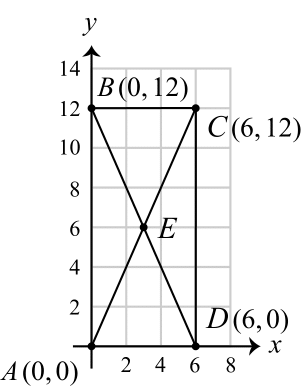
The diagonals of a rectangle intersect at the centre of the rectangle. That is, E is the midpoint of AC. Thus, the x-coordinate of E is the average of the x-coordinates of A and C, or 20+6=3.
The y-coordinate of E is the average of the y-coordinates of A and C, or 20+12=6, and so the coordinates of E are (3,6).
Consider base AD=6 of △ADE, then its height is equal to the distance from E to the x-axis, which is 6.
The area of △ADE is 21(6)(6)=18.
Solution 2
The diagonals of a rectangle divide the rectangle into 4 non-overlapping triangles having equal area. (You should consider why this is true before reading on.)
Thus, the area of △ADE is equal to 41 of the area of rectangle ABCD or 41(6)(12)=18.
Solution 1
We begin by drawing and labelling a diagram, as shown.
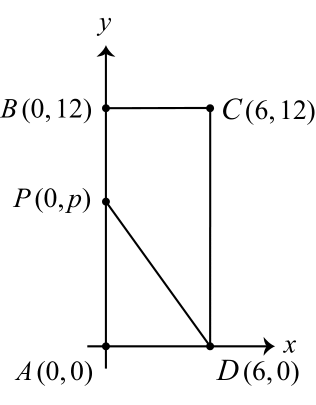
The area of rectangle ABCD is equal to the area of trapezoid BCDP plus the area of △PAD.
Since the area of trapezoid BCDP is twice the area of △PAD, then the area of △PAD is 31 the area of ABCD (and the area of trapezoid BCDP is 32 the area of ABCD).
The area of rectangle ABCD is 6×12=72, and so the area of △PAD is 31×72=24.
The area of △PAD is 21(AD)(AP)=21(6)(p)=3p, and so 3p=24 or p=8.
Solution 2
Point P has coordinates (0,p) and so AP=p and BP=12−p.
The area of △PAD is 21(AD)(AP)=21(6)(p)=3p.
The area of trapezoid BCDP is 21(BC)(BP+CD)=21(6)(12−p+12)=3(24−p).
The area of trapezoid BCDP is twice the area of △PAD, and so 3(24−p)=2(3p) or 24−p=2p, and so 3p=24 or p=8.
The area of rectangle ABCD is 6×12=72.
The sum of the areas of the two trapezoids is equal to the area of rectangle ABCD.
Since the ratio of the areas of these two trapezoids is 5:3, then the areas of the two trapezoids are 85×72=45 and 83×72=27.
(We may check that 45:27=5:3 and 45+27=72.)
Let ℓ be the line that passes through U, V and W.
Begin by assuming ℓ does not pass through a vertex of ABCD. In this case, ℓ either intersects opposite sides of ABCD, or it intersects adjacent sides of ABCD.
If ℓ intersects opposite sides of ABCD, then ℓ divides ABCD into two trapezoids, as required.
If ℓ intersects adjacent sides of ABCD, then ℓ divides ABCD into a triangle and a pentagon. This is not possible.
Assume ℓ passes through at least one vertex of ABCD.
In this case, ℓ divides ABCD into two figures, at least one of which is a triangle. This is not also possible.
Thus, ℓ intersects opposite sides of ABCD and does not pass through A, B, C, or D.
That is, line ℓ can intersect opposite sides of ABCD in the two different ways shown below.
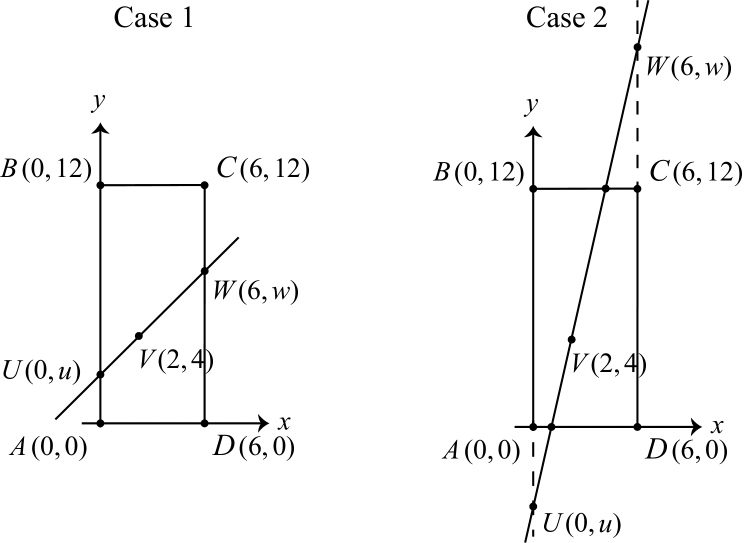
In each case, since ℓ is a straight line passing through U, V and W, then the slope of UV is equal to the slope of VW.
That is, 2−04−u4(4−u)2(4−u)8−2uwamp;=6−2w−4amp;=2(w−4)amp;=w−4amp;=w−4amp;=12−2u
Case 1: Line ℓ intersects sides AB and CD.
That is, U lies between A and B, and W lies between C and D.
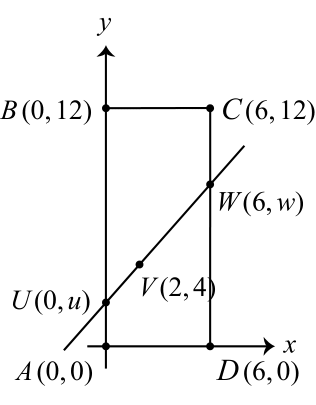
In this case, 0 lt;u lt;12, 0 lt;w lt;12, AU=u, and DW=w.
The area of trapezoid ADWU is 21(AD)(DW+AU)=21(6)(w+u)=3(w+u). Since w=12−2u, the area of trapezoid ADWU becomes 3(12−u).
We consider each of two possibilities: the area of trapezoid ADWU is equal to 27, or the area is equal to 45.
If the area of trapezoid ADWU is equal to 27, then 3(12−u)12−uuamp;=27amp;=9amp;=3 Substituting u=3 into w=12−2u, we get w=12−6=6.
The Case 1 conditions that 0 lt;u lt;12 and 0 lt;w lt;12 are satisfied and thus the ratio of the areas of the two trapezoids is 5:3 for the pair of points U(0,3) and W(6,6).
If the area of trapezoid ADWU is equal to 45, then 3(12−u)12−uuamp;=45amp;=15amp;=−3 Here, the condition that 0 lt;u lt;12 is not satisfied and so there is no pair of points U and W for which the ratio of the areas of the two trapezoids is 5:3.
Case 2: Line ℓ intersects sides AD and BC.
That is, U lies on AB extended, outside of side AB, and W lies on CD extended, outside of side CD.
We begin by drawing and labelling a diagram, including E(e,0) and F(f,12), the points where ℓ intersects sides AD and BC respectively, as shown.
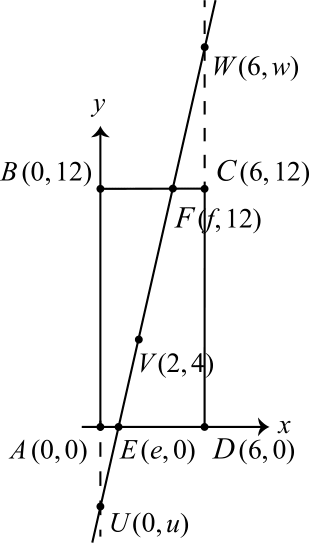
In this case, u lt;0 and w gt;12 (as in the diagram shown), or u gt;12 and w lt;0 (when U lies above B and W lies below D). We note that what follows is true for each of these two cases, and thus we need not consider them separately.
In this case, we require that 0 lt;e lt;6, 0 lt;f lt;6, and so we get BF=f and AE=e.
The area of trapezoid BFEA is 21(AB)(BF+AE)=21(12)(f+e)=6(f+e).
Further, since ℓ is a straight line passing through E, V and F, then the slope of EV is equal to the slope of FV.
That is, 2−e4−02−e44(f−2)f−2famp;=f−212−4amp;=f−28amp;=8(2−e)amp;=2(2−e)amp;=6−2e Since f=6−2e, the area of trapezoid BFEA becomes 6(6−e).
We consider each of two possibilities: the area of trapezoid BFEA is equal to 27, or the area is equal to 45.
If the area of trapezoid BFEA is equal to 27, then 6(6−e)6−eeamp;=27amp;=29amp;=23 Substituting e=23 into f=6−2e, we get f=3, and these values satisfy the Case 2
conditions 0 lt;e lt;6 and 0 lt;f lt;6.
Here, we get E(23,0) and F(3,12) and use these points to determine U and W.
The slope of FV is 3−212−4=8 and so the slope of WV is also 8, which gives 4w−4=8,
and solving we get w=36.
Similarly, the slope of VU is also 8, which gives 24−u=8, and solving we get u=−12.
We note that w=36 and u=−12 satisfy the conditions w gt;12 and u lt;0 and so the ratio of the areas of the two trapezoids is 5:3 for the points U(0,−12) and W(6,36).
If the area of trapezoid BFEA is equal to 45, then 6(6−e)6−eeamp;=45amp;=215amp;=−23 Here, the condition that 0 lt;e lt;6 is not satisfied and so there is no pair of points E and F and thus no pair of points U and W for which the ratio of the areas of the two trapezoids is 5:3.
Thus, there are two pairs of points U and W for which the ratio of the areas of the two trapezoids is 5:3. These are U(0,3), W(6,6), and U(0,−12), W(6,36).