We begin by placing E(4,4)
on CD, as shown.
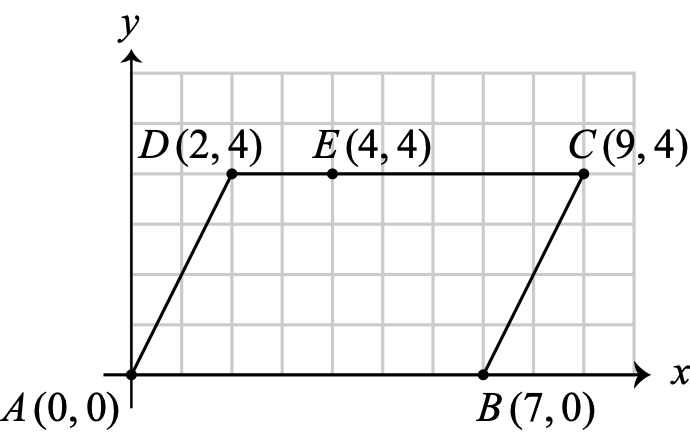
To determine the area of each of the three triangles, consider the
base of each to be AB.
Points C, D and E each have the same y-coordinate, 4, and so each lies on the horizontal
line y=4.
The height of each of the three triangles is the vertical distance
between the line y=4 and the x-axis (the line through A and B), which is 4.
Since AB=7, then the area of
each of the three triangles is 21×7×4=14.
The sum of the areas of △ABC, △ABD, and
△ABE is 3×14=42.
△CDG has non-zero
area, so G cannot lie on CD.
On AB, there are 8 possible
locations for G.
These are the points (k,0) for the
integers 0≤k≤7.
On AD, (1,2) is the only additional point for
which the coordinates are both integers. Similarly, (8,2) is the only additional possibility
for G on BC. The points (1,2) and (8,2) are labelled M and N respectively, as shown.
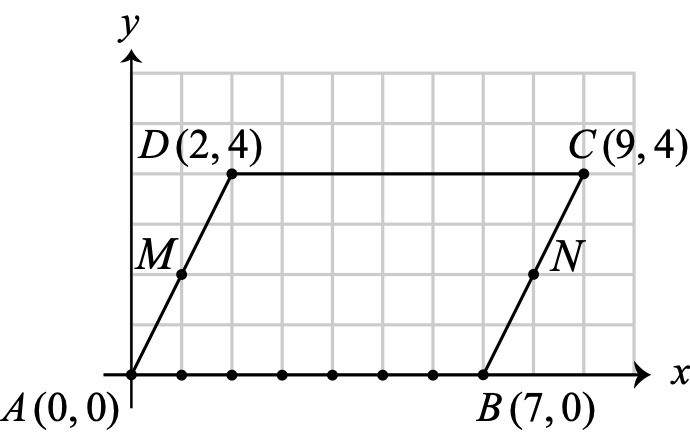
In total, there are 10
possibilities for the point G.
Each such triangle has three vertices chosen from the 18 points with integer coordinates on the
perimeter of ABCD, provided that
the three vertices are not all on the same line.
These 18 points with integer
coordinates are the 8 points on
AB (including A and B), the 8 points on CD (including C and D), and the 2 points M(1,2) and N(8,2).
Each such triangle is described by exactly one of the following
cases:
the number of triangle vertices at M and N is 0
the number of triangle vertices at M and N is 1
the number of triangle vertices at M and N is 2
Case 1: the number of triangle vertices at M and N is 0.
In this case, 2 vertices are on
AB and 1 vertex is on CD, or vice versa.
Consider the triangles with 2
vertices on AB and 1 vertex on
CD.
Consider the base of each such triangle to lie along AB.
There is 1 such triangle with
vertices at A(0,0) and B(7,0), and thus has base length 7.
There are 2 such triangles with
base length 6. One of these
triangles has vertices at A(0,0)
and (6,0), and the other has
vertices at (1,0) and B(7,0).
Continuing in this way, there are 3
triangles with base length 5, 4 triangles with base length 4, 5
triangles with base length 3, 6 triangles with base length 2, and 7 triangles with base length 1.
Each of these triangles has height 4 since all points on CD are a vertical distance of 4 from any base that lies along AB (as in part (a)).
Suppose Q is one such point on
CD having integer
coordinates.
The sum of the areas of all triangles having 2 vertices on AB and 1 vertex at Q is 21×4×(1(7)+2(6)+3(5)+4(4)+5(3)+6(2)+7(1))=21×4×84=168
Also, for each of these bases, there are 8 possibilities for the third vertex that
lies on CD. These are the points
(k,4) for integers 2≤k≤9.
Thus, the sum of the areas of all triangles having 2 vertices on AB and 1 vertex on CD is 168×8=1344.
In a similar way, the sum of the areas of all triangles having 2 vertices on CD and 1 vertex on AB is also 1344, and so the sum of the areas of all
triangles in Case 1 is 1344×2=2688.
Case 2: the number of triangle vertices at M and N is 1.
This case can be divided into the following two subcases:
2 vertices are on AB (or 2 vertices are on CD), and 1 vertex is M or N
1 vertex is on AB, 1 vertex is on CD, and 1 vertex is M or N
Subcase 2(i): 2
vertices on AB (or 2 vertices on CD), and 1 vertex is M or N.
Consider the triangles with 2
vertices on AB and 1 vertex at either M or N.
Consider the base of each such triangle to lie along AB.
The numbers and lengths of these bases are the same as in Case 1.
Each of these triangles has height 2 since M and N are each a vertical distance of 2 from any base that lies along AB.
The sum of the areas of all triangles having 2 vertices on AB and 1 vertex at M is 21×2×(1(7)+2(6)+3(5)+4(4)+5(3)+6(2)+7(1))=21×2×84=84
Also, for each of these bases, the third vertex could also be N.
Thus, the sum of the areas of all triangles having 2 vertices on AB and 1 vertex at either M or N is 84×2=168.
In a similar way, the sum of the areas of all triangles having 2 vertices on CD and 1 vertex at either M or N is 168, and so the sum of the areas of all
triangles in Subcase 2(i) is 168×2=336.
Subcase 2(ii): 1 vertex is on AB, 1 vertex is on CD, and 1 vertex is M or N.
Consider two fixed points with integer coordinates, point P on AB, and point Q on CD.
In the diagram, △PMQ and
△PNQ are two such
triangles described by Subcase 2(ii).
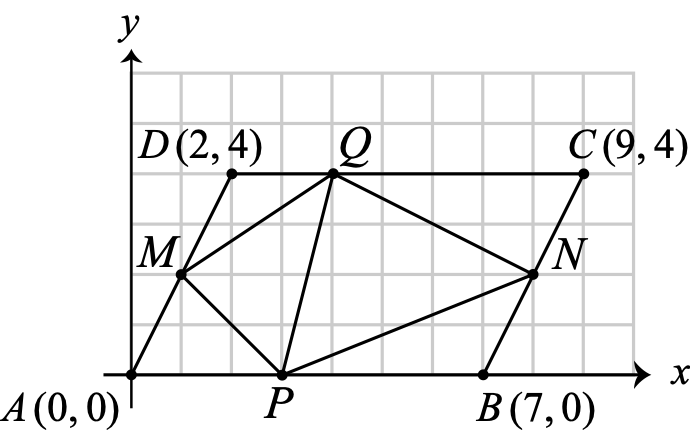
The sum of the areas of △PMQ and △PNQ is
equal to the sum of the areas of △PMN and △QMN.
Consider the base of both △PMN and △QMN to
be MN, which has length 7. Then the height of each triangle is
2.
Thus, the sum of the areas of △PMN and △QMN is
2×21×2×7=14.
There are 8 possible locations for
P and 8 possible locations for Q, and thus 8×8=64 different pairs of triangles
PMN and QMN whose areas have a sum of 14. (You should confirm for yourself that
this is true even when P is (0,0) or (7,0) and/or when Q is (2,4) or (9,4).) The sum of the areas of all
triangles in Subcase 2(ii) is 14×64=896.
Case 3: the number of triangle vertices at M and N is 2.
In this case, 1 vertex is on
AB (or on CD), 1 vertex is M, and 1 vertex is N.
Consider the triangles with vertices M, N, and 1 vertex on AB.
Consider the base of each such triangle to be MN=7. Then each triangle has height 2.
Since there are 8 possible vertices
on AB, then the sum of all such
triangles is 21×2×7×8=56. In a
similar way, the sum of the areas of all triangles having vertices M, N, and 1 vertex on CD is also 56, and so the sum of the areas of all
triangles in Case 3 is 56×2=112.
The sum of the areas of all triangles whose vertices have integer
coordinates and lie on the perimeter of ABCD is 2688+336+896+112=4032.