A median is a line segment drawn from a vertex of a triangle to the midpoint of the opposite side of the triangle.
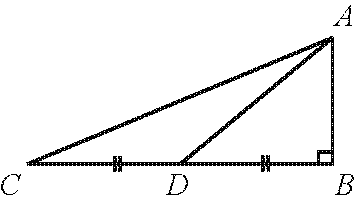
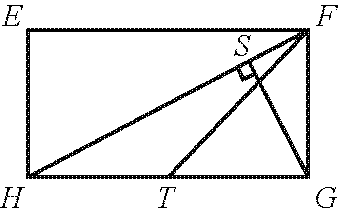
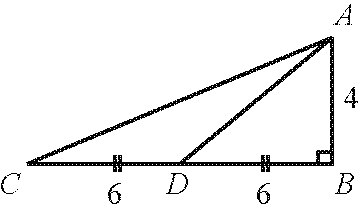
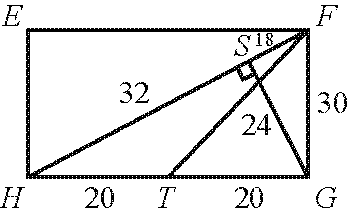
In the diagram, △ABC is right-angled and has side lengths AB=4 and BC = 12. If AD is a median of △ABC, what is the area of △ACD? In rectangle EFGH, point S is on FH with SG perpendicular to FH. In △FGH, median FT is drawn as shown.
If FS=18, SG=24 and SH=32, determine the area of △FHT.
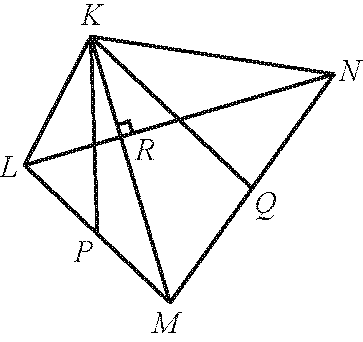
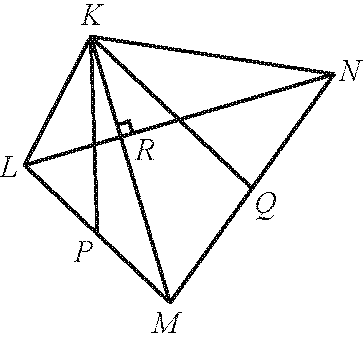
In quadrilateral KLMN, KM is perpendicular to LN at R. Medians KP and KQ are drawn in △KLM and △KMN respectively, as shown. If LR=6, RN=12, KR=x, RM=2x+2, and the area of KPMQ is 63, determine the value of x.
Solution
Solution 1
In △ABC, AD is a median and so D is the midpoint of BC.
Since BC=12 and D is the midpoint of BC, then CD=212=6.
In △ACD, base CD has length 6, and corresponding height AB has length 4. (Since ∠ABC=90∘, AB is the height of △ACD even though AB is outside △ACD.)
Thus, △ACD has area 21(6)(4)=12.
Solution 2
In △ABC, AD is a median and so D is the midpoint of BC.
Since BC=12 and D is the midpoint of BC, then CD=DB=6.
In △ABD, AB=4, DB=6, and ∠ABD=90∘, and so △ABD has area 21(6)(4)=12.
Similarly, △ABC has area 21(12)(4)=24, and so the area of △ACD is the area of △ABC minus the area of △ABD, or 24−12=12.
Solution 3
In △ABC, AB=4, BC=12, and ∠ABC=90∘, and so △ABC has area 21(12)(4)=24.
A median of △ABC divides the triangle into two equal areas. Why?
In △ABC, AD is a median and so D is the midpoint of BC.
Therefore, △ACD and △ABD have equal bases (CD=BD).
Further, the height of △ABD is equal to the height of △ACD (both are AB).
Thus, △ACD and △ABD have equal bases and equal heights.
Since the area of each triangle equals one-half times the base times the height, then △ABD and △ACD have equal areas and so median AD divides △ABC into equal areas.
Since △ABC has area 24, then △ACD has area 224=12. Solution 1
In △FSG, FS=18, SG=24, and ∠FSG=90∘.
Thus, by the Pythagorean Theorem, FG=182+242=324+576=900=30 (since FG gt;0).
Since S is on FH so that FS=18 and SH=32, then FH=FS+SH=18+32=50.
In △FGH, FH=50, FG=30, and ∠FGH=90∘.
Thus, by the Pythagorean Theorem, GH=502−302=2500−900=1600=40 (since GH gt;0).
In △FGH, FT is a median and so T is the midpoint of GH.
In △FHT, base HT=240=20, and height FG=30. (Since ∠FGH=90∘, FG is the height of △FHT even though FG is outside △FHT.)
Thus, △FHT has area 21(20)(30)=300.
Solution 2
Since S is on FH so that FS=18 and SH=32, then FH=FS+SH=18+32=50.
In △FGH, base FH=50, and height SG=24 (since SG is perpendicular to FH, SG is a height of △FGH).
Thus, △FGH has area 21(50)(24)=600.
The median of a triangle divides the area of the triangle in half.
(Solution 3 to (a) shows an example of why a median divides a triangle’s area in half.)
Since FT is a median of △FGH, then the area of △FHT=2600=300. We use the notation ∣△KLM∣ to represent the area of △KLM, ∣KPMQ∣ to represent the area of KPMQ, and so on.
In △KLM, KP is a median and so 2∣△KPM∣=∣△KLM∣.
(Solution 3 to (a) shows an example of why a median divides a triangle’s area in half.)
In △KMN, KQ is a median and so 2∣△KMQ∣=∣△KMN∣.
Therefore, ∣KLMN∣=∣△KLM∣+∣△KMN∣=2∣△KPM∣+2∣△KMQ∣ and ∣KPMQ∣=∣△KPM∣+∣△KMQ∣ which tells us that ∣KLMN∣=2∣KPMQ∣.
Since ∣KPMQ∣=63, then ∣KLMN∣=2∣KPMQ∣=2(63)=126.
Now ∣KLMN∣=∣△KRL∣+∣△LRM∣+∣△KRN∣+∣△NRM∣.
Each of these four triangles is right-angled.
Since KR=x and LR=6, then ∣△KRL∣=21x(6)=3x.
Since LR=6 and RM=2x+2, then ∣△LRM∣=21(6)(2x+2)=6x+6.
Since KR=x and RN=12, then ∣△KRN∣=21x(12)=6x.
Since RN=12 and RM=2x+2, then ∣△NRM∣=21(12)(2x+2)=12x+12.
Therefore, 126=3x+(6x+6)+6x+(12x+12) or 126=27x+18 or 27x=108 and so x=4.
Want a route through all this instead of an archive? The track
puts 2,604 problems in a working order, from Junior Challenge level to the IMO shortlist.