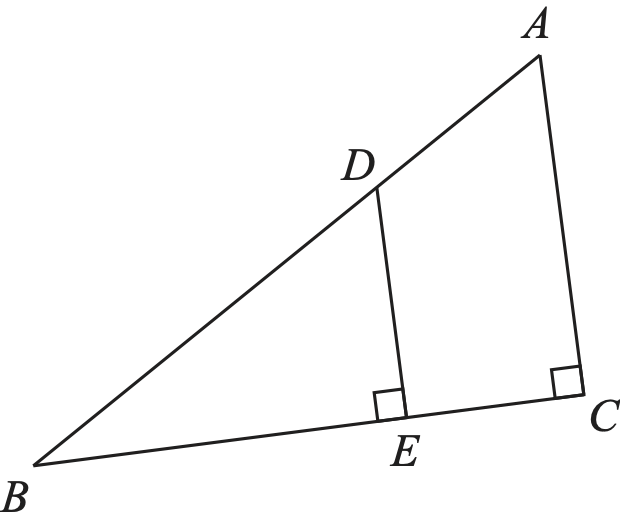
Solution 1:
Suppose that BE=AC=x and
DE=y.
Extend BC to point F so that BC=DE=y.
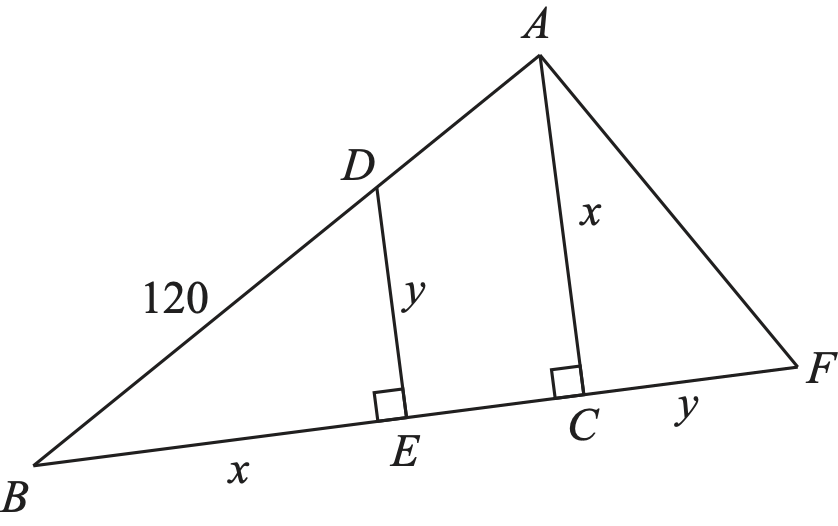
Since BC+DE=288, then BF=BC+CF=BC+DE=288.
Also, △BED is congruent to
△ACF by
side-angle-side.
Therefore, ∠BAF=∠BAC+∠ACF=∠BDE+∠DBE=90° since DE and AC are parallel.
Next, △BED is similar to
△BAF since both are
right-angled and they share an angle at B.
Therefore, BDDE=BFFA and so 120DE=288120, which
gives DE=288120⋅120=50, as required.
Solution 2:
Suppose that BE=AC=x and
DE=y.
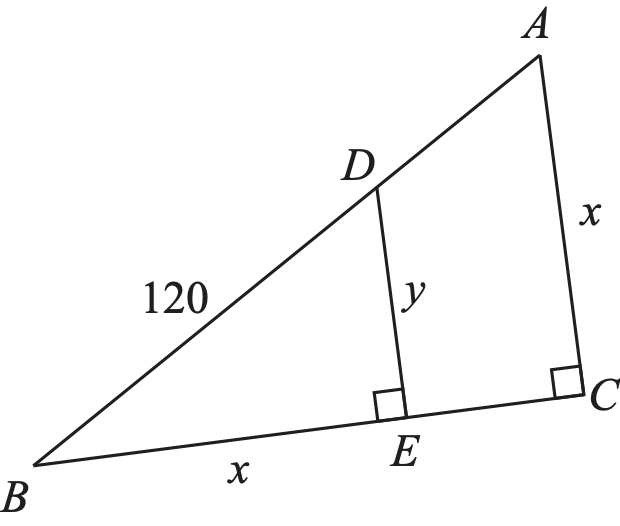
Since DE+BC=288, then BC=288−y.
We note that △BED is
similar to △BCA because
each is right-angled and their angles at B are common.
Therefore, DEBE=ACBC and so yx=x288−y.
Manipulating, we obtain x2=y(288−y) and so x2=288y−y2 or x2+y2=288y.
Also, using the Pythagorean Theorem in △BED gives x2+y2=1202.
Since x2+y2=288y and x2+y2=1202, then 288y=1202 which gives 2⋅12⋅12⋅y=120⋅120 and so 2y=10⋅10 or y=50.
Therefore, DE=50.