CombinatoricsDifficulty 4.7AIMEFind the answerCanada
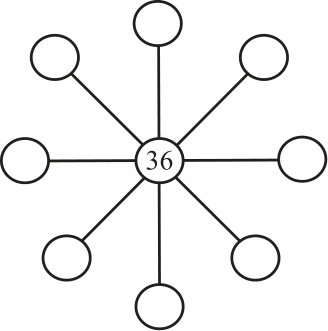
In the diagram, the central circle contains the number 36.
Positive integers are to be written in the eight empty circles, one number in each circle, so that the product of the three integers along any straight line is 2592. If the nine integers in the circles must be all different, what is the largest possible sum of these nine integers?
160 176 178 195 216
A number or a short expression. Fractions can be typed as 3/2, and spacing doesn't matter.
Solution
If the product of three numbers x, 36 and y is 2592, then x⋅36⋅y=2592 and so xy=362592=72. If x and y are positive integers with xy=72, then we have the following possibilities:
x
y
x+y
72
1
73
36
2
38
24
3
27
18
4
22
12
6
18
9
8
17
We have assumed that x gt;y since we have not assigned an order to x, 36 and y. In the given problem, we want to put four pairs of numbers in the outer circles so that the 9 numbers are different and the sum of the 9 numbers is as large as possible. Putting this another way, we want to choose 4 of the 6 pairs in the table above (knowing that we cannot choose the pair 36 and 2 since 36 is already in the middle circle) to make the sum as large as possible. Since we know the sums of the pairs, we choose the pairs with the four largest sums. This means that the sum of the 9 numbers will be (72+1)+(24+3)+(18+4)+(12+6)+36 which equals 73+27+22+18+36 or 176.
Want a route through all this instead of an archive? The track
puts 2,604 problems in a working order, from Junior Challenge level to the IMO shortlist.