Given a sequence of real numbers. For each () define
and let
a. Prove that for arbitrary real numbers ,
b. Show that there exists a sequence of real numbers such that we have equality in (1).
Given a sequence of real numbers. For each () define
and let
a. Prove that for arbitrary real numbers ,
b. Show that there exists a sequence of real numbers such that we have equality in (1).
(a) Let be indices for which
and thus . (These indices are not necessarily unique.)
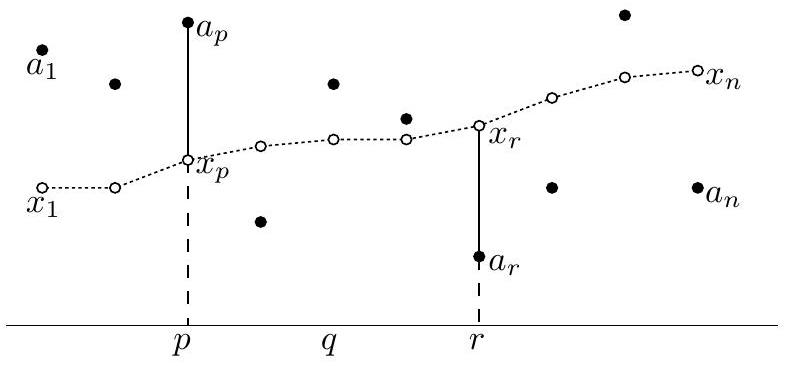
For arbitrary real numbers , consider just the two quantities and . Since
we have either or . Hence,
(b) Define the sequence as
We show that we have equality in (1) for this sequence.
By the definition, sequence ( ) is non-decreasing and for all . Next we prove that
Consider an arbitrary index . Let be the smallest index such that . We have either , or and . In both cases,
Since
equality (3) implies
We obtained that for all , so
We have equality because .
We present another construction of a sequence ( ) for part (b).
For each , let
For all , we have
and
Therefore sequences ( ) and ( ) are non-decreasing. Moreover, since is listed in both definitions,
To achieve equality in (1), set
Since sequences ( ) and ( ) are non-decreasing, this sequence is non-decreasing as well.
From we obtain that
Therefore
Since the opposite inequality has been proved in part (a), we must have equality.